57. Lesser Horseshoe Bat

I’ve finally started on bats for my new company! For most of last summer I was a sub-contractor for a local ecologists and 90% of my work was assisting with bat surveys; which basically involved sitting and staring at a corner of a building for an hour or so around dawn or dusk. This was aided by a variety of bat detectors; I was normally given a smart bit of tech which clips on to an iPad or similar and runs an app which converts bat echo-locations into sounds humans can hear, as well as converting it into a sonogram so we can see the bat call, and thirdly tried to ID the bat. The latter was hit in miss with many species, dogs barking and keys jangling were often ID’d as Noctule bats. My new company doesn’t use the clever tech, it uses older tech to silently record bats and a handheld hetrodyne detector which the user has to twiddle around to pick up different bat types (usually set to 45 kHz as a default). My new company doesn’t seem to do many buildings either, this morning I was staring at a tree and a couple of nights ago I was staring at a cave entrance. Where I saw today’s subject…

What: Lesser Horseshoe Bat Rhinolophus hipposideros (Bechstein, 1800)

When: 27th May 2020

Where: The UK (got to be vague on this one I think).

Who saw it? My colleague and I.

How was it recorded? On a form which goes into the local record centres.

Is it bigger than a blackbird? No, a small bat. Think about a mouse with wings and your’re almost there (the wings do make them seem a little bigger than a mouse though).

What is it? A pretty special bat. Well all bats are special in my opinion but some are more special than others to paraphrase Animal Farm. All of my previous bat surveys have involved the commoner species, pipistrelles mostly along with a smattering of Noctules, various Myotis species and if we were really lucky Brown Long-eared Bats. Pretty much all these have an association with humans, or live in open countryside. The Lesser Horse-shoe is much rarer and more picky where it lives. They (and I’m only basing this on my survey the other day), live in caves during the winter (and maybe some abandoned buildings in the summer I believe) and behave almost like stereotypical spooky bats. They like to fly around in their caves to warm up before they begin to emerge and go about their nightly business and like to wrap themselves up in their wings whilst hanging upside down from roofs. They also emit a spooky noise when converted through a bat detector. They are now emerging from their winter cave roosts and will head to their various summer breeding roosts. They are a declining species and are now extinct in various places in England. This is more than likely due to disturbance or destruction of their breeding sites amongst other reasons. They are light brown in colour and have one of those ugly bat noses which is shaped like a horseshoe, which gives them their English name.

A fact I have learned about this species: All of the above is new to me! But, they (along with the even rarer in the UK Greater Horseshoe Bat) use a unique type of echolocation which is both more constant, and higher in frequency (110 KHz) than the rest of the UK bat fauna.
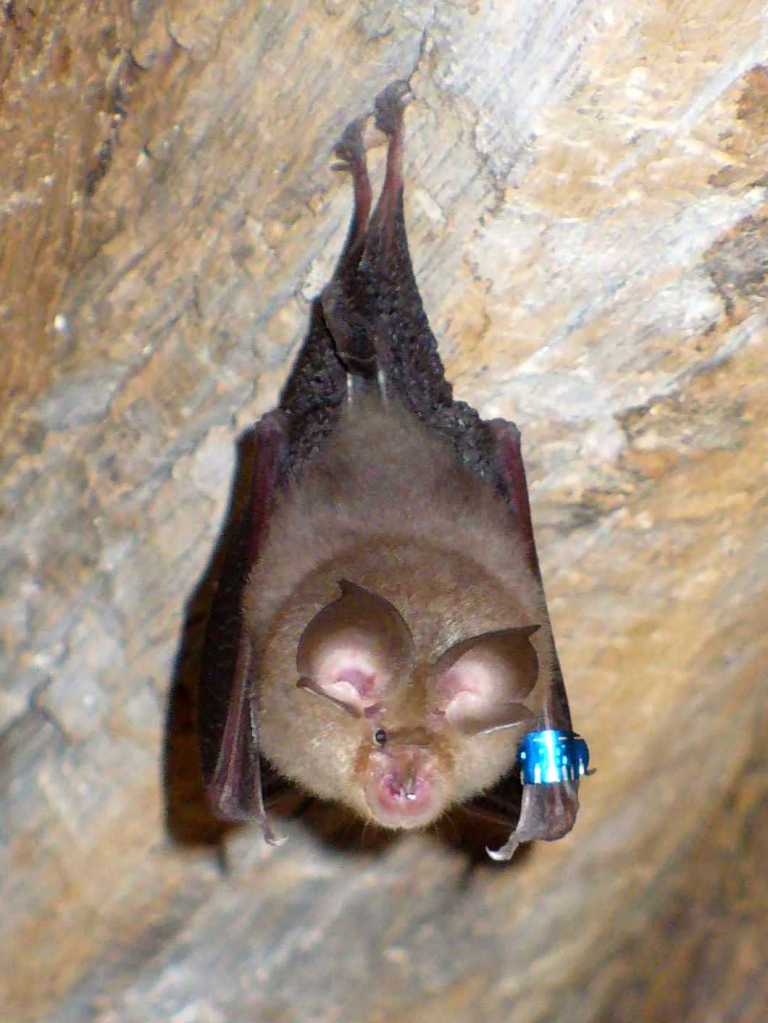
Lesser Horseshoe Bat with a wing tag (Photo: Lylambda via WikiCommons)

Is it charismatic in my opinion? I think from my enthusiastic write up this gets a big yes. Obviously all bats are enigmatic too, you barely see them, but when you get to know them they are full of character.
56. Smooth Newt

Another 10 days has passed since my last post. Still eeking them out though! I’ve spent probably 5 minutes (but felt like a lot longer) just staring at this screen trying to think of a subject. Truth is I’ve not been out for my own pleasure for ages. The local park is less appealing at this time of year (it’s far better in winter for birds), plus it’s way too busy with one thing or another happening. The local nature reserve has had its gates shut, it’s still open but parking is an issue. Plus, I manage to get out for work, so going out for pleasure almost seems like a bus man’s holiday; I mean it isn’t – I spent 50% of my time at work on a laptop, and being on the computer in my own free time doesn’t feel like a continuation of work for some reason, but maybe the blog does, who knows! I realise I’ve spent most of the last few intros to these things in a similar vein; justifying to myself why I’m doing less of these and explaining away my apathy in general. Anyway, hopefully the next one will have a different intro! On with the show…

What: Smooth Newt Lissotriton vulgaris (Linnaeus, 1758)

When: Every time I survey for work it seems, but also 8th May 2020

Where: My garden, Poynton, Cheshire, UK

Who saw it? My dad and I.

How was it recorded? On the iRecord app.

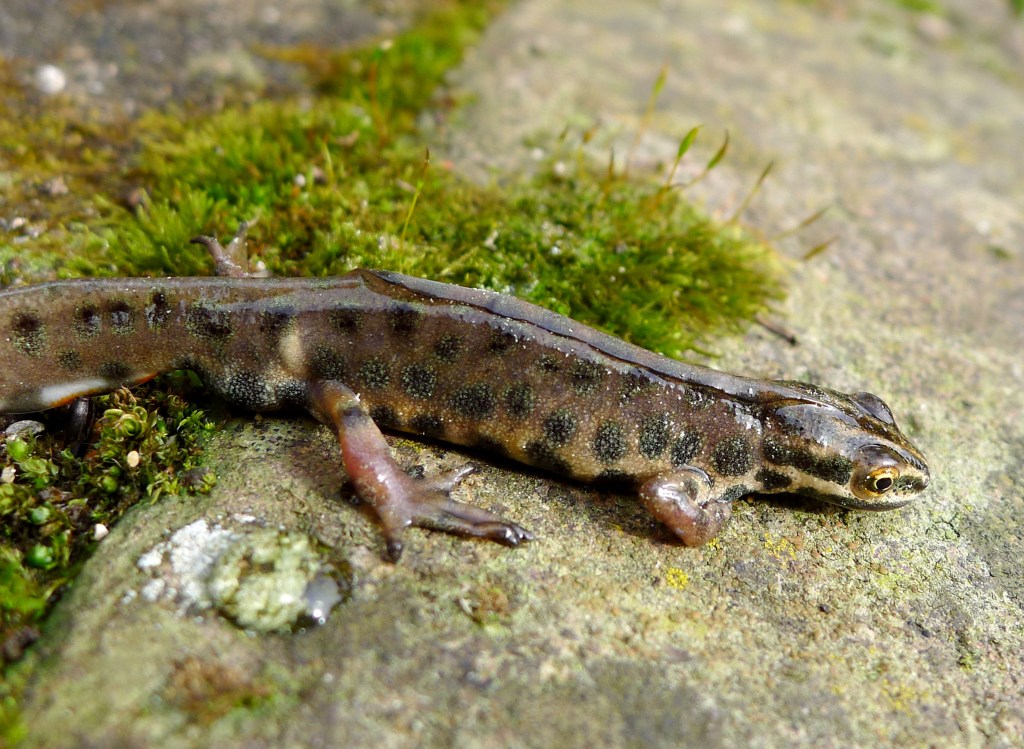
What is it? One of the three native UK newt species. A few posts ago I featured the Great Crested Newt, which is the largest of the three species and the most highly protected. The smooth is more common and is less picky on habitat, in the breeding season they like smaller bodies of water as well as the slightly larger ponds the Cresties inhabit. They are also less picky in the non-breeding season, where they become terrestrial. It is quite common to find them under plant pots for example in more suburban settings. They are approximately half the size of Cresties and are (as they name suggests) smooth skinned as opposed to the Cresty’s warty rough skin. The males in the breeding season have a large crest like their larger cousins but theirs are uninterrupted all the way from the head to the end of the tail, whereas the Great Crested has a slight pause in the crest where the tail starts. The females are unassuming and mostly light brown in colour (I’ve seen males in both light and dark brown); they are very similar to the closely related Palmate Newt (the third UK native newt). Like all native amphibians they lay eggs in freshwater which develop into a larval tadpole stage before emerging as tiny versions of adults.

Is it larger than a blackbird? No, I’m guessing a blackbird could probably eat a young Smooth Newt they’re that small!

A fact I have learned about this species: Most of the above is new to me this year! However, Wikipedia tells me that Smooth Newts have turned up in Melbourne, Australia this century; presumably as an accidental introduction (my guess of a culprit would be the aquatic garden plant trade?).

Male Smooth Newt (By gailhampshire from Cradley, Malvern, U.K – Male Smooth newt Lissotriton vulgaris, CC BY 2.0, https://commons.wikimedia.org/w/index.php?curid=63756547) – I really ought to have my own picture of one of these!

Are they charismatic in my opinion? I think I hold the same opinion I have for the Great Crested Newt. Just about; had you asked me before I worked with them I would have said no but now I’d say so. They don’t exactly appear to do much when on land but in the water they are a different prospect completely, very active after dark and can be pretty numerous.

55. Poecilus cupreus (a ground beetle)

Blimey, getting longer between posts but I’m still going which is the main thing. I am doing a lot of writing for work as well as being out in the field a lot (still thanking my lucky stars this year!), but enough with the excuses. Today’s post is about one of the obscure things I was mentioning in my last blog which I don’t really know much about, specifically a beetle this time. I have managed to identify it twice (two individuals) using specialist books called keys. I often find ground beetles (ie: the ones you see crawling across your lawn, not the ones in the trees or on plants – loose description) in the pitfall traps I use to capture and remove newts from building sites and it set my curiosity off, so I have captured a few to take home to identify (they need to be euthanised in order to be identified; but there are thousands of them and in order to be able to protect something you first need to know what you are protecting, and in the case of small creatures, euthanising one or two leads to identification). So onto the specific beetle…

What: Poecilus cupreus (Linnaeus, 1758) – One thing to mention here, one of my keys has a different genus (the first part of the name), but that has been superseded by the one here; something to look for when identifying small relatively unknown creatures (and occasionally well known ones!).

When: 5th May 2020

Where: Winsford, Cheshire (VC58), UK

Who saw it? Me (ID’d it too but this needs checking by someone who has more experience with beetles)

How was it recorded? On iRecord.

Is it bigger than a blackbird? Hmmm… it’s a beetle so what do you think?!

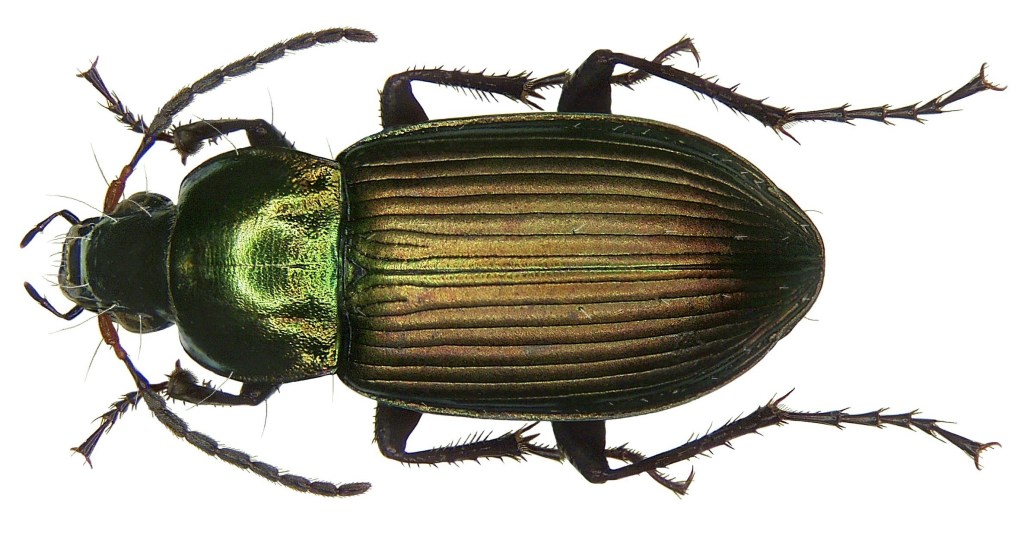
What is it? A medium sized (11-13 mm) ground beetle which is green/copper in colour (it has a slight iridescent sheen which makes it look one colour or the other). From what I can tell they live in fields and in dry areas and are more common the south of England than in the north. And that’s about it; not much more information I can find about them without delving into a dusty library somewhere or undertaking a PhD.

A fact I have found out about this species: Well, everything, including what it is to begin with. But apparently it is found in every country in Europe except the smaller islands (and San Marino and Andorra; it must hate small countries…).

Ain’t beetles pretty?! (Photo: Udo Schmidt via WikiCommons)

Is it charismatic in my opinion? Erm, not a clue. Ground beetles have made me pay attention to them in general, but as for this species? Who knows…

54. Swift

My mojo is definitely leaving this blog! Alas the gaps between posts are getting wider. No idea why exactly. I do write a lot for work now, admittedly very controlled, templated, and dry texts so nothing like this, which is basically words from my head written directly to here (which is probably why these look like they need a good edit!). Anyway, so there’s plenty of things to write about, lots of migratory birds I’ve seen, lots of breeding birds, some ground beetles I’ve managed to identify (one of my ideas of the blog was to write about obscure stuff, stuff that i’d only just learned about). A lot of which i’ve thought.. “now there’s a blog post” which I’ve never got round too. Take yesterday, my first swifts of the year, a few weeks ago I would have raced to the laptop and rattled off a post. Now, it’s taken 24 hours and a real effort to open WordPress. Anyway, I’ve done it so I shall continue…

What: Swift Apus apus (Linnaeus, 1758)

When: 4th May 2020

Where: Over my house, Poynton, Cheshire, UK

Who saw them? My dad and I.

How was it recorded? I haven’t yet, another loss of mojo sign alas.. will probably go on eBird when I finish writing this, I’ve also seen them today.

Are they bigger than a blackbird? Hard to say, they are bigger than swallows but maybe not bigger than a blackbird, probably similar in size.

What is it? One of the last breeding visitors to these shores. They arrive in very late April and early May – and are usually gone by early August, so they don’t hang around either. They come to breed in our roof spaces and under eaves of houses and their screaming calls are the iconic sound of summer in my opinion (seriously, find a drama series which doesn’t use the sound of swifts in a summer scene). They are also quite an urban and suburban bird in the UK and are not as often encountered in open countryside. They traditionally nested in trees before humans invented buildings apparently, and still do in certain parts of the world (I’m talking the Common Swift, there are other swift species that breed outside the UK who nest in all sorts of places). The swifts (as a group) are the fastest birds in a world in a straight line – ie: unaided by gravity, and they are constantly on the move. You won’t find a swift perching, and you won’t see them on the ground, unless they’ve fallen out the nest or miscalculated, and in which case they struggle to take off they are that bound to the air, the only time the choose to land is when they go to their nests in the breeding season. Our swifts (Apus apus) migrate to the south of Africa, like swallows – see a previous post, and won’t land again until they return to their nests the next year. Swifts are not at all related to the similar looking swallow; the two species are an example (I think) of convergent evolution, two different starting points evolving in a similar direction getting to two types of bird with similar functions. (I like to think of it as two inventors in two different countries unknowingly inventing the same thing – like the lightbulb for example).

A fact you may not know about this species: Swifts (as a family) closest relatives are the hummingbirds (the eyes are the key, they do look similar if you look at them closely).

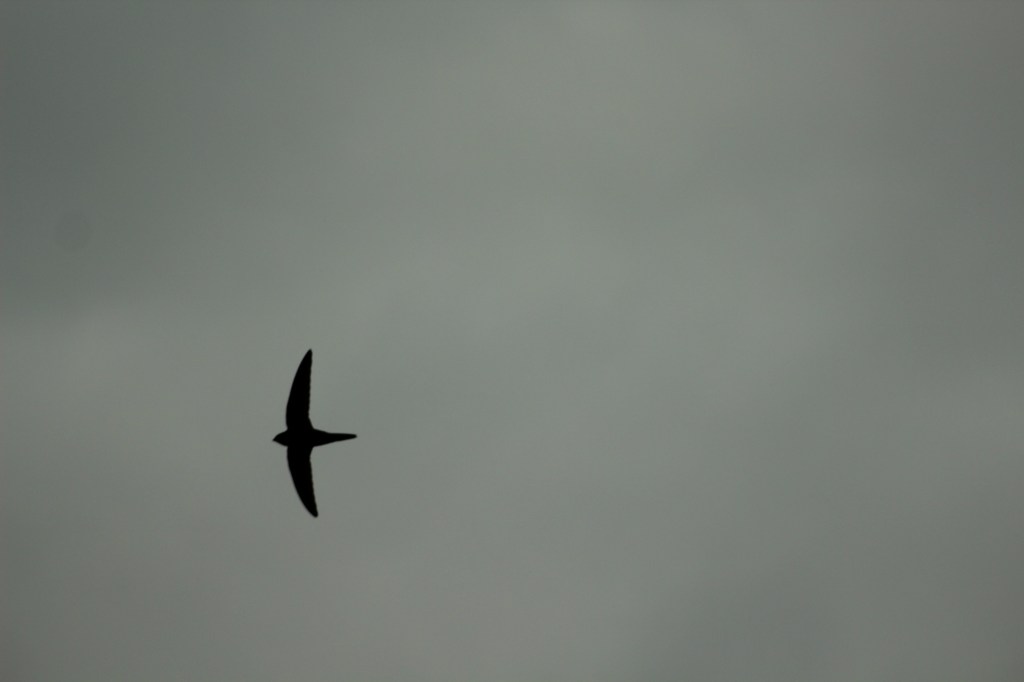
Swifts are so hard to take a picture of, but an amazing challenge – like photographing an F1 race. This is one (of hundreds) flying over Lakenheath Fen, Norfolk in 2017. It needs lightening but I like the silhouette effect (Photo: Alex Cropper)

Are they charismatic in my opinion? Yes oh hell yes! No further answers (other than they are also very enigmatic, just out of reach…).

53. Red-eared Terrapin (or Slider)

It’s been over a week since my last post. No excuses other than lethargy and being relatively busy at work (okay, two excuses!). I’ve actually barely been out walking around my park, I went last Friday and this Friday (as in yesterday) and that’s it. Granted my work allows me out onto sites, which is a lucky godsend in the current climate, so I’m not totally devoid of the outdoors and I have seen and heard some decent wildlife which may form future blogs (if I get my finger out and start writing these regularly again). Today’s subject is something I saw both yesterday and my previous trip to the park (plus lots of others) and is something which isn’t normally associated with the UK.

What: Red-eared Terrapin (Slider) Trachemys scripta (Schoepff, 1792)

When: 24th April 2020

Where: Poynton Pool, Cheshire, UK.

Who saw it? Me and a lot of others who I heard commenting on them.

How was it recorded? On the iRecord app.

Is it bigger than a blackbird? Yes, standard loaf of bread sized I’d say.

What is it? A terrapin, a non-native terrapin. Actually, all terrapins are non-native to the UK, we only have six native species of reptile and terrapins aren’t one of them (although there is a species of terrapin native to mainland Europe, just not here). This particular terrapin is native to the USA and Mexico where it lives in warm freshwater. So it seems reasonable to think that one living in the cool (and often frozen in the winter) waters of northern England wouldn’t live very long. Well that would be wrong. They can live in these conditions, but thankfully, these waters are too cold for them to re-produce as there eggs need warm water in order to be fertile (I believe). The ones in the UK stem from the pet trade, as these terrapins were once popular pets (sale now banned), popular pets in the early 90s when the Teenage Mutant Ninja Turtles (or Hero Turtles here) were popular amongst kids, your’s truly included. So, some people wanted turtles of their own and bought tiny Red-earred Terrapins, which, either as the novelty wore off, or they got too big were then released into local lakes, including my local lake. Thirty years later, these same terrapins are still living in those lakes. The impact to native fauna is debatable, there is a finite population, I think about 6 in my park, and they mostly feed on plants, but would no doubt take small fish and ducklings too. In other, warmer countries there impact has been huge, out-competing native species of terrapin and transmitting diseases, a real problem. But here they are just an odd curiosity which will die off eventually (terrapins, tortoises etc. are notoriously long-lived so they could be here for a good while yet!).

A fact I have learned about this species: All of the above! They hibernate (or “brumate”) underwater over winter, living at the bottom of a lake, and only occasionally popping to the surface to breathe.

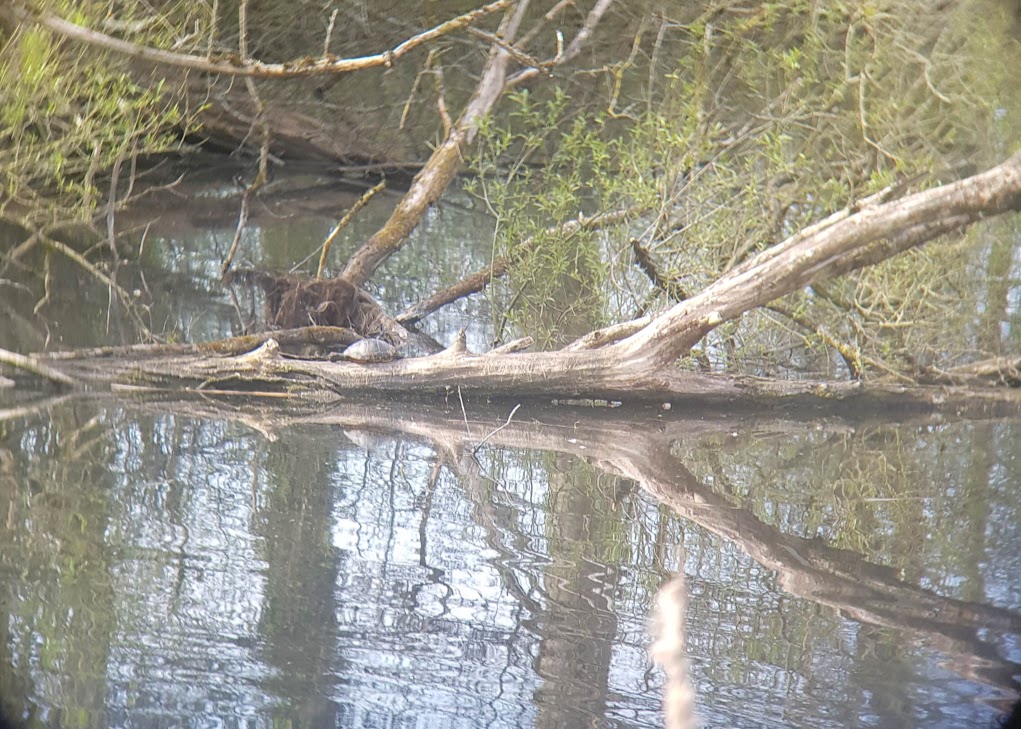
Not my greatest photo, actually taken through my binoculars. But clearly shows a terrapin basking on a fallen tree. (Photo: Alex Cropper)

Is it charismatic in my opinion? Hmmm.. it’s one of those species that is highly successful and gets under human’s skin, but does have a huge impact on native wildlife (but not here in the UK). But I’ve not seen them do anything other than bask and be lazy on overhanging branches. They are a talking point however, but I think I would say no, they aren’t charismatic. I’m willing to change have my mind changed though,

52. Great Crested Newt

I’m almost halfway through my new job; I should be half way through the first month of my new job, but hey circumstances. My job is pretty standard ecological consultancy basics in the UK – at this time of the year that means helping out Great Crested Newts. Now, as many people who work around them know, the GCN (as those in the know call them) predominantly live in and around future or current building sites. Most building sites in the UK have been mothballed for now, but handful haven’t, so all the ecological work that supports them must carry on. GCN are one of the most protected species in the UK, and need removing from the building sites for work to happen, which is where I come in.

What: Great Crested Newt Triturus cristatus (Laurenti, 1768)

When: 12th & 13th April 2020

Where: Winsford, Cheshire, UK

Who saw it? My colleagues and I.

How was it recorded? Sighting submitted via company to inform building works.

Is it bigger than a blackbird? No, but they are pretty big for an amphibian.

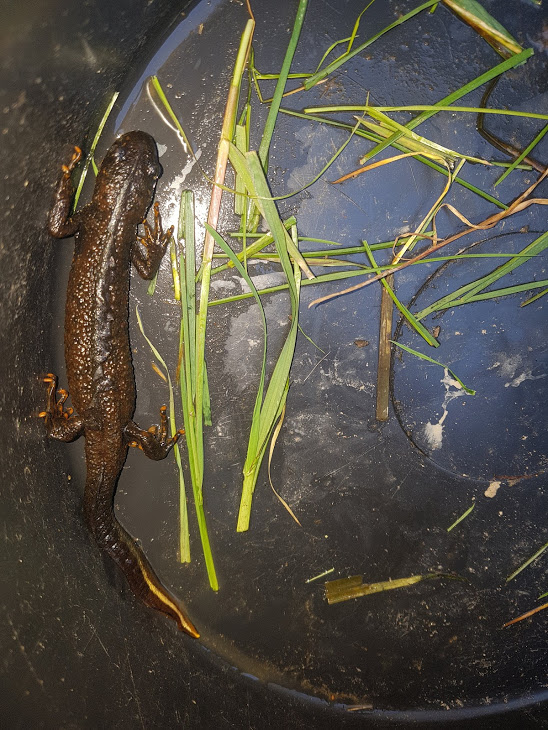
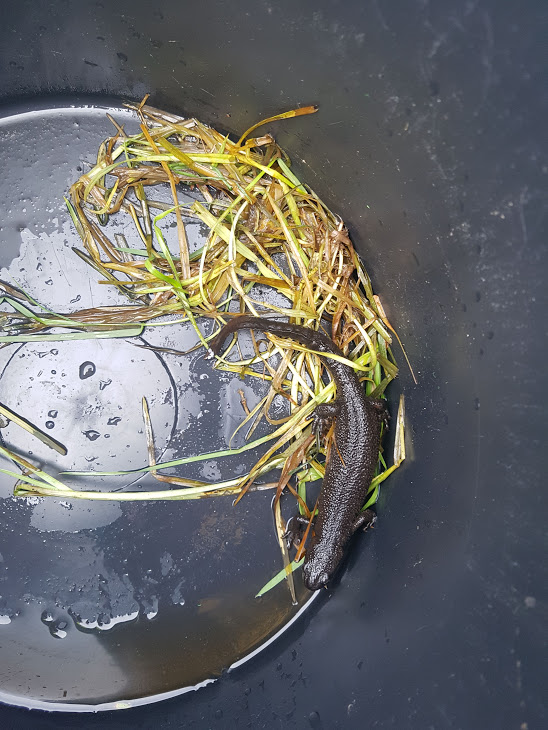
What is it? An amphibian in the Salamandrid family; which consists of salamanders (as the name implies) and newts. There are three native species of newt in the UK, the Great Crested, the Smooth, and the Palmate. The GCNs are about twice the size of the other two species and have narrower habitat requirements than their relatives, hence why they are endangered and are fully protected. They like old ponds, namely ponds that supplied drinking water to cattle, ponds which as farming methods modernise are becoming surplus to requirement. So the ponds in farmland are being filled in, and a lot more have been destroyed due to suburban expansion into the countryside. Thankfully, the requirements of the GCN (there are a lot more, but this is an overview) are now well known and it is possible to remove them from the sites and transfer them to new, or existing ponds, crucially ponds that won’t be destroyed anytime soon. They are rough to look at, and look black out of the water, they have a bright orange underbelly with distinct markings; very contrasting. The males have a crest at this time of the year, which is very noticeable in the water, less so out of it.

A fact I have learned about this species: In fairness most of the above is new to me, I’ve had to learn the basics quick in order to understand them and my job. But maybe this one sticks out: They are encountered in every county in England, except Cornwall, no idea why this should be, maybe a lack of suitable ponds? Or there are too many witches there looking for eyes of newts, who knows?!

Is it charismatic in my opinion? I actually would have said no a week ago. But now having seen and handled one (under license) I have changed my mind. They have character, admittedly they don’t move very quickly but they are certainly alert and don’t prentend to be dead (at least not for very long). They are probably mostly enigmatic, most people haven’t seen one and they are nocturnal so most people probably won’t do, but most people will have heard of the Great Crested Newt.

Lockdown Bird List: A geeky interlude

Bit of a departure for this post. I’ve been seeing a lot of wildlife in the time since my last post, mostly out my window, but once from a site visit for work (couldn’t be done from home). But instead of picking a species (I will do in subsequent posts) I’ll list my bird sightings from the lockdown period, which, in the UK started on the 23rd of March. The rules are birds I’ve seen in my garden or flown over the house, and birds seen on my patch which I walk around as part of my government approved exercise time out of the house. I changed my walking location a few days into the lockdown to avoid a short drive so now it is the park (Poynton Pool) I walk to rather than the slightly further away nature reserve (Jackson’s Brickworks); so a few of the birds are from there. Anyway on with the list… Oh before I start I should point out I’m not normally someone who avidly keeps a bird list, I normally find it akin to trainspotting, but these are special times.

  • Greylag Goose Anser anser
  • Pink-footed Goose Anser brachyrhynchus
  • Canada Goose Branta canadensis
  • Mute Swan Cygnus olor
  • Mallard Anas platyrhynchos
  • Tufted Duck Aythya fuligula
  • Great Crested Grebe Podiceps cristatus
  • Feral Pigeon Columba livia
  • Stock Dove Columba oenas
  • Woodpigeon Columba palumbus
  • Collared Dove Streptopelia decaocto
  • Moorhen Gallinula chloropus
  • Coot Fulica atra
  • Oystercatcher Haematopus haematopus
  • Herring Gull Larus argentatus
  • Lesser Black-backed Gull Larus fuscus
  • Cormorant Phalacrocorax carbo
  • Grey Heron Ardea cinerea
  • Buzzard Buteo buteo
  • Jay Garrulus glandarius
  • Magpie Pica pica
  • Jackdaw Corvus monedula
  • Rook Corvus frugilegus
  • Carrion Crow Corvus corone
  • Coal Tit Periparus ater
  • Blue Tit Cyanistes caeruleus
  • Great Tit Parus major
  • Barn Swallow Hirundo rustica
  • Chiffchaff Phylloscopus collybita
  • Long-tailed Tit Aegithalos caudatus
  • Goldcrest Regulus regulus
  • Nuthatch Sitta europaea
  • Wren Troglodytes troglodytes
  • Starling Sturnus vulgaris
  • Song Thrush Turdus philomelos
  • Mistle Thrush Turdus viscivorus
  • Blackbird Turdus merula
  • Robin Erithacus rubecula
  • Dunnock Prunella modularis
  • House Sparrow Passer domesticus
  • Chaffinch Fringilla coelebs
  • Bullfinch Pyrrhula pyrrhula
  • Greenfinch Chloris chloris
  • Lesser Redpoll Acanthis cabaret
  • Goldfinch Carduelis carduelis

45 species by my count (I can’t count though!). Modest by some standards (I’ve seen equivalent lists of approaching 100) but okay for a tiny suburban garden and a suburban park. Highlights so far are the Pink-footed Goose which was by itself and on the ground when it should be well on it’s way back to above the Arctic Circle by now, and the Oystercatcher which I heard fly over the house a couple of nights ago.

Will update this sporadically for as long as the lockdown continues (not long hopefully! well probably will be long but got to be optimistic).

51. Buff-tailed Bumblebee

Wow, 3 posts in 3 days, feels like January again! I handed my dissertation in, which means my Masters course is done! No more studying (of course, I like to learn all the time – so no more formal studying! woo!)! Day 4 of my new job and as a consequence of being a general lack of work due to the C word I’ve spent a fair bit of time staring out of my ‘office’ window in between emails. The cherry tree in my garden has just come into blossom and I have noticed a lot of insects visiting, so I got my binoculars from downstairs to see what some of them were, and lo and behold I managed to identify a bumblebee.

What: Buff-tailed Bumblebee Bombus terrestris (Linnaeus, 1758)

When: 6th April 2020

Where: My garden, Poynton, Cheshire, UK

Who saw it? Me.

How was it recorded? I haven’t recorded it yet.

Is it bigger than a blackbird? I’m not even going to dignify that with an answer.

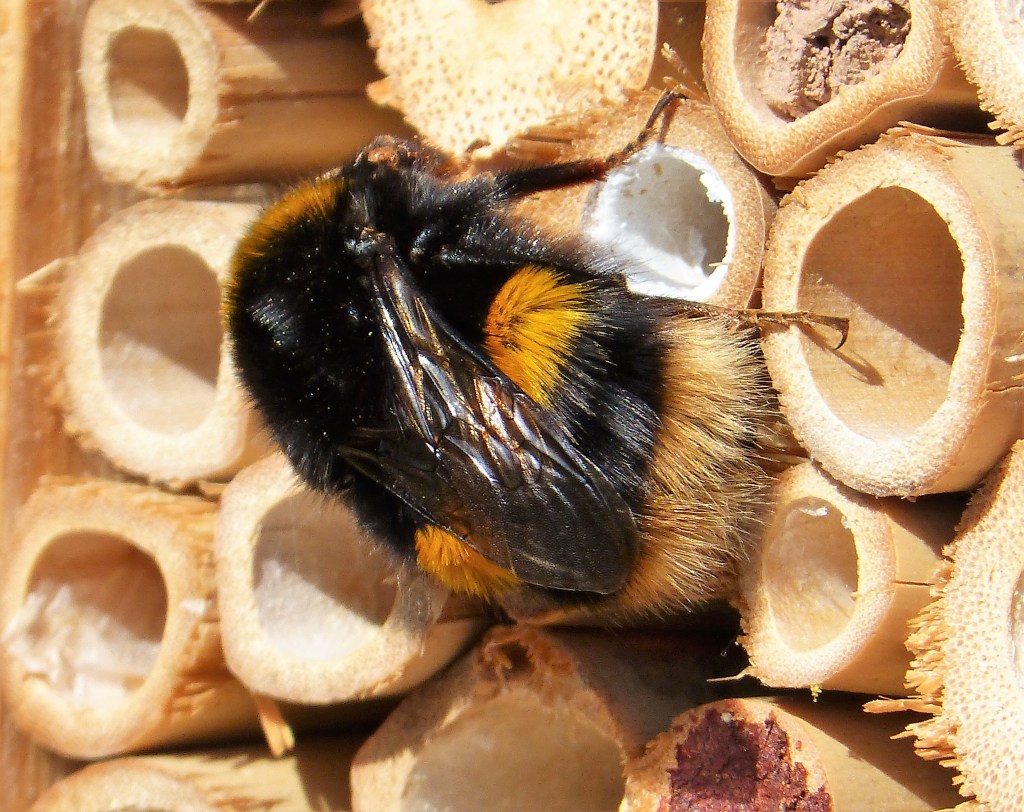
What is it? A large furry member of the bee family, and more specifically a member of the genus Bombus a.k.a the bumblebees. The buff-tailed is a very common bumblebee in the UK but can be hard to identify. At this time of the year they are relatively easy as there are mostly only queens around, and it is they who have the off-white buffy tails. However, the workers and males (who appear later and will be more numerous) have less buff-coloured which look almost white; which makes them almost identical to another species – the White-tailed Bumblebee B. lucorum agg. (the agg. stands for aggregate as this ‘species’ is actually 3 species). I am confident of mine being a buff as I could clearly see the colouring, and as I say the time of year; queens appear first having overwintered as adults, they then find a burrow to lay pre-fertilised eggs from the previous autumn which pass through the larval stage to emerge as worker bees later in the spring. Buff-tails make their nests underground.

A fact about this species: It is usually the first species of bumblebee to emerge in late winter/ early spring.

A Wiki Commons photo clearly showing the buff tail (Photo: By gailhampshire from Cradley, Malvern, U.K – Buff-tailed Bumble bee. Bombus terrestris, CC BY 2.0, https://commons.wikimedia.org/w/index.php?curid=69988281)

Is it charismatic in my opinion? I think so (I know I start a lot of these like this!). As far as insects go they are big and obvious. And if one flies into your house you let it out rather than try to swat it. That has to count for something, human respect may be? They always seem busy and determined as they seek out flowers (but this applies to all bumblebees I think).

50. (Barn) Swallow

Spring can now officially begin. The swallows (or a swallow) have arrived in my part of the world. Whilst a single swallow doesn’t make a summer it sure makes a spring! It was an odd trip out for my daily exercise walk; certain abuses of the privilege around the country could curtail any such activity for everyone, so I decided to walk round the park a lot later in the day than usual in hope of increased social distancing (I always stay well away from anyone anyway but needing to lessen the risk is always forefront of my mind instead of cancelling and living as a dangerously depressed hermit). Wildlife was behaving differently as a result of less people around, most of the geese were in the middle of the park, on the grass, rather than in the water like usual, and there were different species of goose, not just the usual Canadas, there were Greylags and, surprisingly, a solitary Pink-footed Goose. And then a swallow flew over, not linked to lack of people, they are due anyway but still it was nice to see on an odd late-afternoon.

What: (Barn) Swallow Hirundo rustica Linnaeus, 1758

When: 5th April 2020

Where: Poynton Pool, Cheshire, UK

Who saw it: Me

How was it recorded? Using the eBird app.

Is it bigger than a blackbird? Slightly smaller

What is it: A swallow, everyone knows what one is right? A highly migratory song bird that appears in the Northern Hemisphere at this time of the year having overwintered in southern Africa (the European ones do at least). There are many species of swallow around the world but the Barn Swallow occurs both in Europe and Africa, as well as in the Americas. The European/African birds having white bellies, and the American birds having buff-yellow bellies. They are blue/black on top, with a distinct orange/red faces. Adult birds have long streamers. Highly accomplished fliers, they can happily spend most of the day on the wing. They are not related to the later arriving Swifts which bear a superficial resemblance, but are related to House Martins (which will also be beginning to appear in the UK about now).

A fact I have learned about this species: One of the few bird species that naturally occurs on all continents on Earth bar Antarctica (The Barn Swallow, has six sub-species, so they will be all superficially different but the same nevertheless).

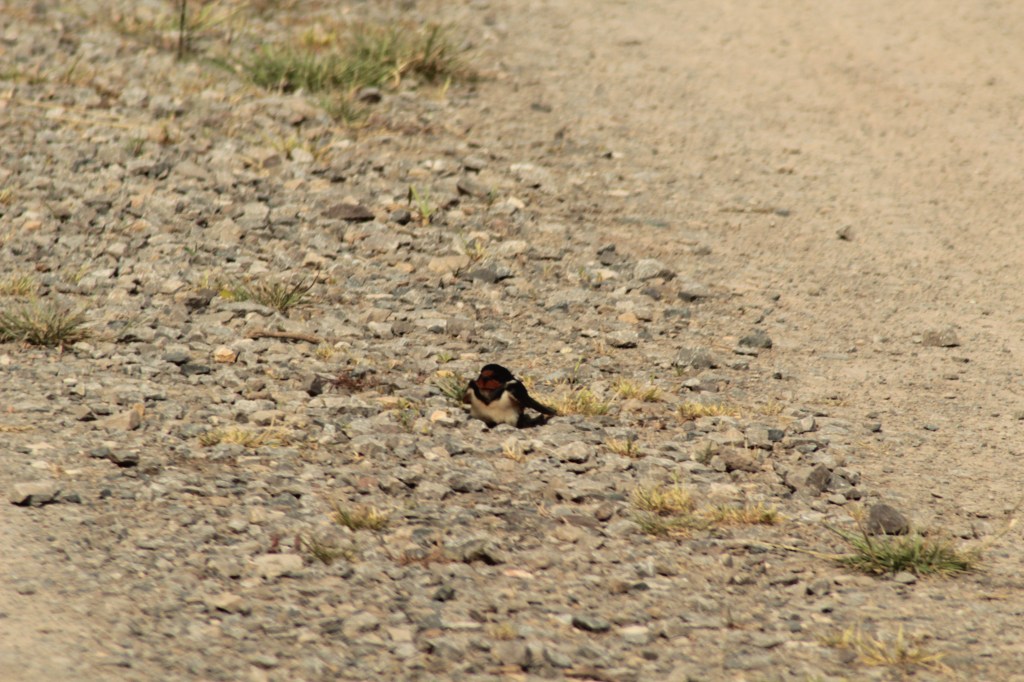
A swallow basking on the ground in Somerset a few summers ago (Photo: Alex Cropper)

Are they charismatic in my opinion: Yes of course. They are possibly the bird of spring, when they arrive you know winter is over. And when they are here en masse they can gather in huge numbers. A small lake can be teeming with them as they skim the water’s surface for emerging insects; they never stop moving seem full of energy, I do love them!

49. Cuckooflower

I have been really busy over the last few days, started a new job and have been subsequently stuck to my sofa all day as a result, it’s not easy to start a job and immediately work from home! And then I’ve been finishing off my dissertation, which barring a final read through and tidy-up is now ready to be handed in. So, basically I haven’t been out the house since Tuesday; great for social distancing but terrible for the soul (and my ‘fitness’). Anywho, managed to get out and walk around my local parka again for my daily government approved walk.

What: Cuckooflower (or Lady’s Smock) Cardamine pratensis L.

When: 4th April 2020

Where: Poynton Pool, Cheshire (VC58), UK

Who saw it? Me

How was it recorded? On iRecord.

Is it bigger than a blackbird? No.

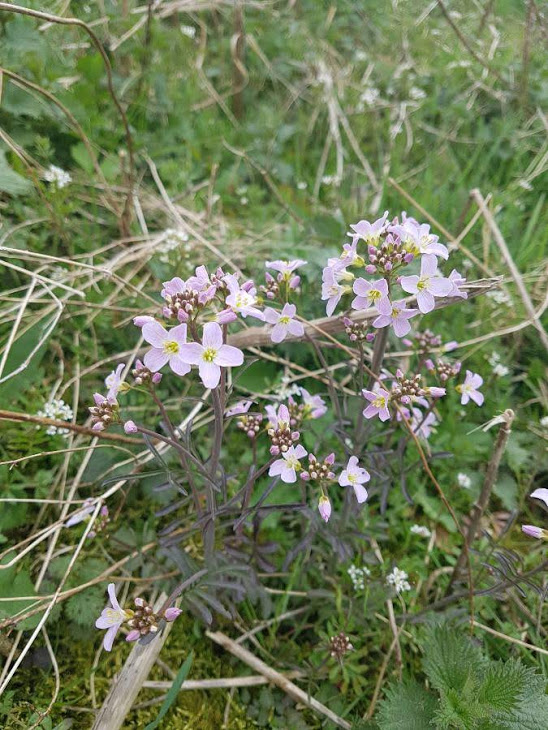
What is it? A member of the cabbage (or brassica) family which occurs in damp places usually. A spring flower, lilac/pink in colour with four petals and obvious long yellow stamens. The leaves are dark green in colour with a purple tinge and are small and slender. They are one of the plants with numerous English names, the two most common being Cuckooflower, as they are said to come into flower when the cuckoo starts singing, and Lady’s Smock. They must be one of the best reasons to only use the scientific name, as Cardamine pratensis is universal and unlikely to cause confusion. The leaves are apparently edible and are peppery in taste (I feel a lot of unlikely edible plants are ‘peppery,’ ramsons certainly are for instance).

A fact I have learned about this species: According to the wild plant charity Plantlife, they are the county flower of Cheshire, where I live. Nice to knowingly see my first one here then.

Cardamine pratensis at Poynton Pool (Photo: Alex Cropper) – plants are way easier to take photos of quickly than birds!

Is it pretty in my opinion? See, I’ve now changed charismatic to pretty for plants! Although I am the wrong person to cast judgement on a plant’s prettiness, I think I really need to stereotypically be an 8 year old girl to cast true judgement! But yes I think it is, made me look twice at it anyway!

Design a site like this with WordPress.com
Get started