My mojo is definitely leaving this blog! Alas the gaps between posts are getting wider. No idea why exactly. I do write a lot for work now, admittedly very controlled, templated, and dry texts so nothing like this, which is basically words from my head written directly to here (which is probably why these look like they need a good edit!). Anyway, so there’s plenty of things to write about, lots of migratory birds I’ve seen, lots of breeding birds, some ground beetles I’ve managed to identify (one of my ideas of the blog was to write about obscure stuff, stuff that i’d only just learned about). A lot of which i’ve thought.. “now there’s a blog post” which I’ve never got round too. Take yesterday, my first swifts of the year, a few weeks ago I would have raced to the laptop and rattled off a post. Now, it’s taken 24 hours and a real effort to open WordPress. Anyway, I’ve done it so I shall continue…
What: Swift Apus apus (Linnaeus, 1758)
When: 4th May 2020
Where: Over my house, Poynton, Cheshire, UK
Who saw them? My dad and I.
How was it recorded? I haven’t yet, another loss of mojo sign alas.. will probably go on eBird when I finish writing this, I’ve also seen them today.
Are they bigger than a blackbird? Hard to say, they are bigger than swallows but maybe not bigger than a blackbird, probably similar in size.
What is it? One of the last breeding visitors to these shores. They arrive in very late April and early May – and are usually gone by early August, so they don’t hang around either. They come to breed in our roof spaces and under eaves of houses and their screaming calls are the iconic sound of summer in my opinion (seriously, find a drama series which doesn’t use the sound of swifts in a summer scene). They are also quite an urban and suburban bird in the UK and are not as often encountered in open countryside. They traditionally nested in trees before humans invented buildings apparently, and still do in certain parts of the world (I’m talking the Common Swift, there are other swift species that breed outside the UK who nest in all sorts of places). The swifts (as a group) are the fastest birds in a world in a straight line – ie: unaided by gravity, and they are constantly on the move. You won’t find a swift perching, and you won’t see them on the ground, unless they’ve fallen out the nest or miscalculated, and in which case they struggle to take off they are that bound to the air, the only time the choose to land is when they go to their nests in the breeding season. Our swifts (Apus apus) migrate to the south of Africa, like swallows – see a previous post, and won’t land again until they return to their nests the next year. Swifts are not at all related to the similar looking swallow; the two species are an example (I think) of convergent evolution, two different starting points evolving in a similar direction getting to two types of bird with similar functions. (I like to think of it as two inventors in two different countries unknowingly inventing the same thing – like the lightbulb for example).
A fact you may not know about this species: Swifts (as a family) closest relatives are the hummingbirds (the eyes are the key, they do look similar if you look at them closely).
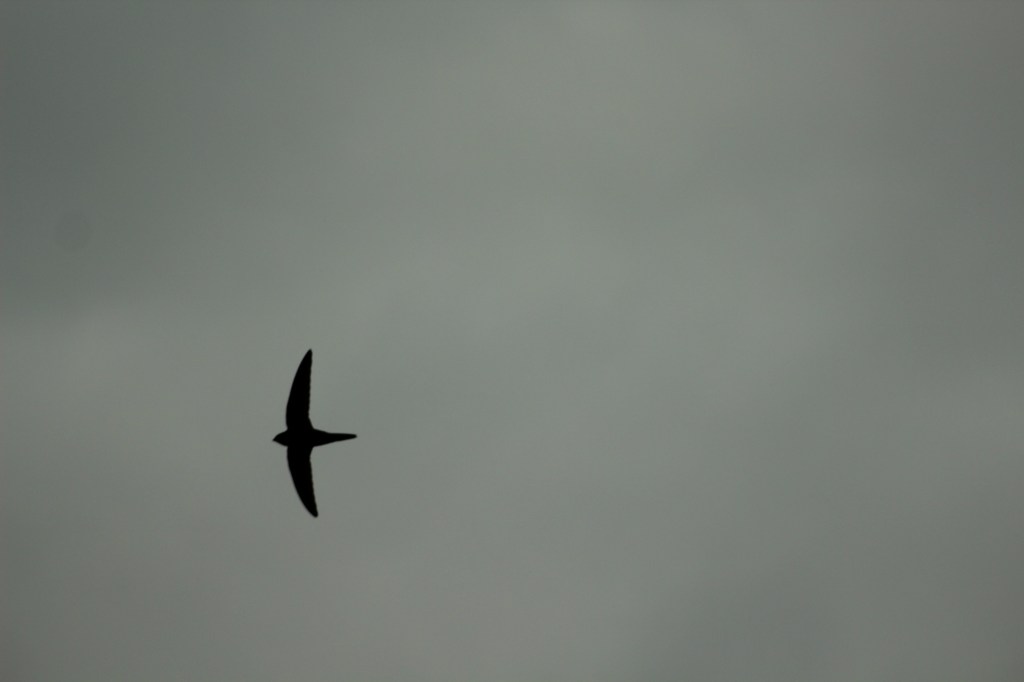
Are they charismatic in my opinion? Yes oh hell yes! No further answers (other than they are also very enigmatic, just out of reach…).

