Day 19 – Fox

I was sorely tempted to write about another thrush today as another species appeared in my garden today, but I thought two in two days is a bit much; best save it for a rainy day. So today’s species is one that I encountered on the way home from work in the early hours of the morning and subsequently kept me awake earlier with its barking. Plus I have my own photo rather than having to go down the Wiki Commons route!

What: (Red) Fox Vuples vulpes (Linnaeus, 1758)

When: 19th January 2020

Where: Poynton, Cheshire, UK

Who saw it? Me

Is it bigger than a blackbird? Yes, obviously, it’s a fox!

What is it? It’s a fox. Red/orange coloured fur with a white belly and a bushy tail. They can be found throughout the entire northern hemisphere and, rather stupidly, been introduced to Australia for some reason; stupid colonialists! They are related to domestic dogs, both being in the Canidae or Canine family. For centuries in the UK they were hunted and ripped apart in the name of sport, a practice now illegal and on the wain although illegal hunting still takes place. They can still be legally shot as ‘vermin,’ as they do hunt chickens, although they will scavenge for just about anything.

A fact I have learned about this species: Foxes had almost become extinct in the 18th century in England and subsequently vast numbers were imported from elsewhere in Europe during the 19th century in order for them to be hunted. (Ref: Stephens, R. (2003) The Boom of the Bitterbump: The Folk-history of Cheshire’s Wildlife Gordon Emery, Chester)
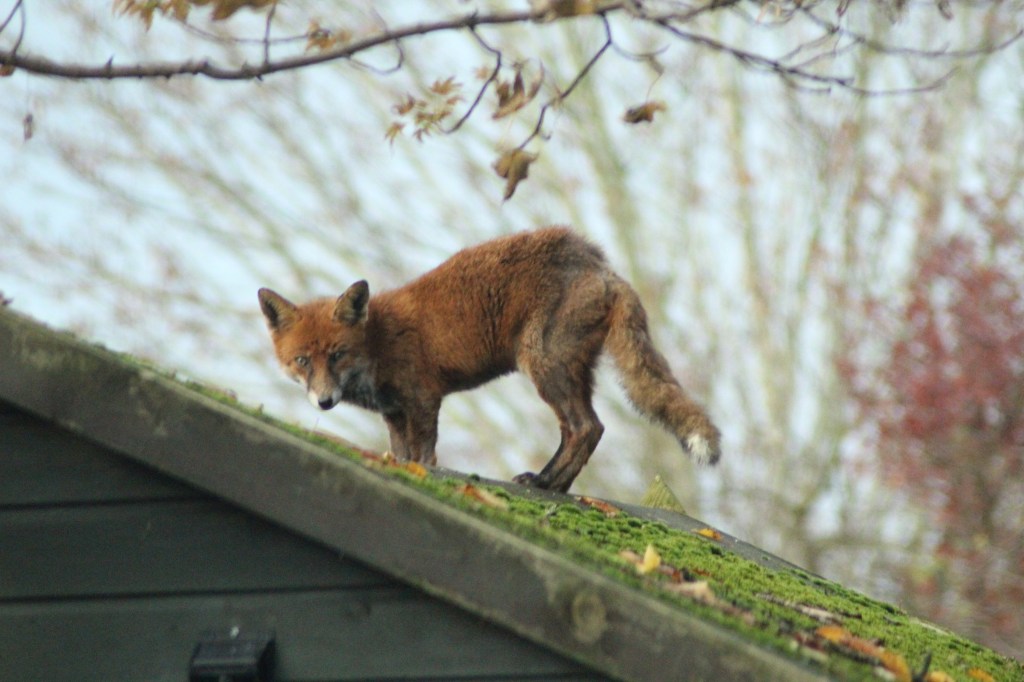
A young fox on my shed rood before Christmas (Photo: Alex Cropper)

Is it charismatic in my opinion? Yes. No doubt. Far to clever and wily to be anything other than charismatic. Another one of those species that bothers us so much that some people like to exterminate it.
Day 18 – Song Thrush

As I try to sit down to write this, yet again my dad comes in to witter on and on and on about whatever subject is in his head at the moment (I’m living with the folks at the mo; not cool I know). He typically comes in when I’m trying to do something important; I’m trying to finish off my Master’s dissertation right now but I swapped to the blog as this takes slightly less concentration. So today’s subject is something else that goes on and on; which coincidentally started talking for the first time this year today.

What: Song Thrush Turdus philomelos Brehm, 1831

When: 18th January 2020

Where: Near my house, Poynton, Cheshire, UK

Who saw it? Me. Heard it rather than saw it.

How was it recorded? On eBird.

Is it bigger than a blackbird? No, it is slightly smaller than it’s relative the blackbird.

What is it? A small member of the thrush genus Turdus (don’t laugh, it’s actually called that). A seemingly non-migratory species in the UK which may be augmented by birds from elsewhere in Europe during the winter. They definitely migrate from other areas as they are legally shot in areas of the Mediterranean during the colder months. They start singing at this time of the year, far earlier than blackbirds, and have a fluting song with repetitive measures. Think maybe of a musician reading sheet music, compared to the freestyle jazz of the blackbird’s similar song. They are declining dramatically in the UK (Ref: Balmer et al (2013)).

A fact I have learned about this species: Song thrushes in the Isles of Scilly, UK, particularly on St. Agnes, rarely fly and are no where near as timid as their mainland cousins. Surely a case of evolution in action, I bet if we were able to time travel a few thousand years forward they will have lost their ability to fly.

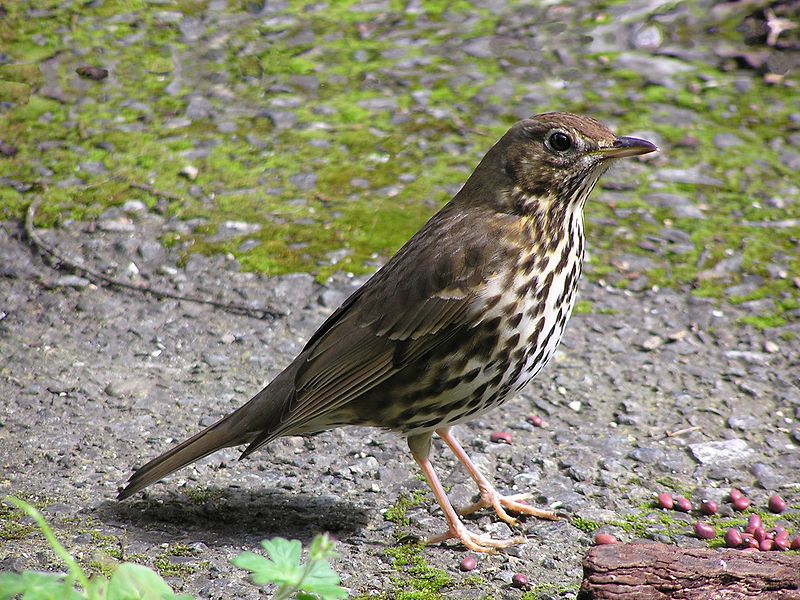
Song Thrush (Photo: Tony Wills via Wiki Commons https://commons.wikimedia.org/wiki/File:Song_thrush.jpg)

Is this species charismatic in my opinion? Yes. They have a habit of finding snails, selecting a suitable stone, and then smashing said snail onto said stone in order to extract the juicy occupant for lunch. They are usually incredibly shy and the only clue to their presence is their song, unless you’re lucky enough to have one visit your garden where they occasionally like to nest.

Bonus pic, to terrible to put as main pic! Two song thrushes on St. Agnes having a stand-off. This was right outside the post office, not shy there at all! (Photo: Alex Cropper)

Day 17 – Japanese Knotweed

The other day whilst surveying birds for the consultancy we came across one of the most invasive non-native plants in the UK. We had already seen it and lots more during the pre-survey recce and habitat survey we completed in December so the owners of the site will find out about it when they receive a report.

What: Japanese Knotweed Fallopia japonica (Houtt.) Ronse Decr.

When: 14th January 2020

Where: a site near Preston Docklands, Lancashire, VC60, UK

Who saw it: My colleague and I

How was it recorded? It will be recorded on the site report.

Is it bigger than a blackbird? Yes

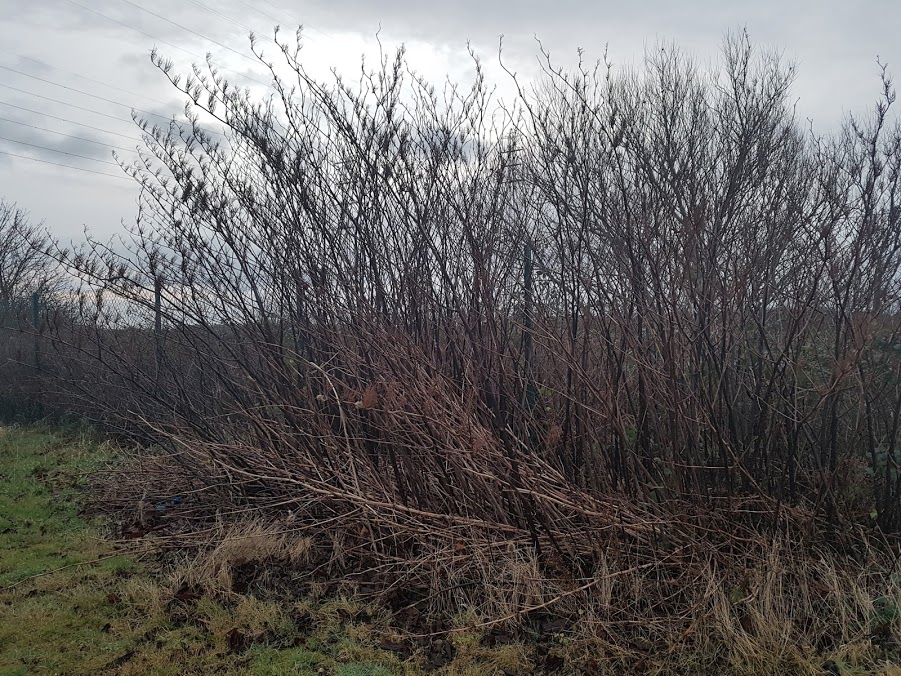
What is it? A species of knotweed that is, as the English name (and scientific name) suggests is native to Japan, and areas of China and Korea too. It was brought to Europe and North America as an ornamental plant where it quickly escaped gardens and became rampant. This species can grow through concrete, so presence in an area can be detrimental to buildings, or potential building works. The root system is particularly strong and the rhyzomes that make new plants are incredibly resilient, surviving in extreme cold and heat and in a variety of soil pH levels. It is therefore incredibly difficult to kill off. I have experience in combating this plant and used pure Glyphosate injected directly into the stem to kill off a patch. This needs to be repeated several times in order to start destabilising the root system below.

A fact I have found out about this species? In the UK all plants are clones of the same female plant (Ref: https://www2.le.ac.uk/departments/genetics/people/bailey/res/f-japonica).

Fallopia japonica (or Reynoutria japonica) aka Japanese Knotweed at a site near Preston, Lancashire, UK (Photo: Alex Cropper)

Is it charismatic in my opinion? It’s a pain in the backside, but like many invasives it’s invasive for a reason. It’s ability to thrive pretty much anywhere and be a pain in the backside to us humans must make it charismatic. Or am I giving it too much credit?

Day 16 – Mute Swan

Just over halfway gone for my initial target of a one species per day for the month of Janaury (also stayed off alcohol too in this period as an aside). Today it’s back to birds. Yesterday, adjacent to the Yew was a pair of Mute Swans who had swam over the lake and presumably saw me as a source of food (they’re not carnivourous, they were probably demanding bread). One of them had a ring on it’s left leg, not a brightly coloured one which can be read from a distance, rather a metal ring. Normally theses rings (or bands as they are known in other English-speaking countries) will only be read if the bird is dead or recaptured. This bird was so tame I could read it as it was stood next to me.

What: Mute Swan Cygnus olor (Gmelin, 1789)

When: 15th January 2020

Where: Poynton Pool, Cheshire, UK

Who saw it? Me

How did I record it? By sending the number on the ring to the BTO https://www.bto.org/our-science/projects/ringing/about-ringing/why-report-ringed-bird

Is it larger than a blackbird? Yes, significantly so. Nb. Just for clarification on my scale, the blackbird I’m referring to is the European Blackbird Turdus merula. For my American readers this is roughly the same size as the closely related American Robin T. migratorius.

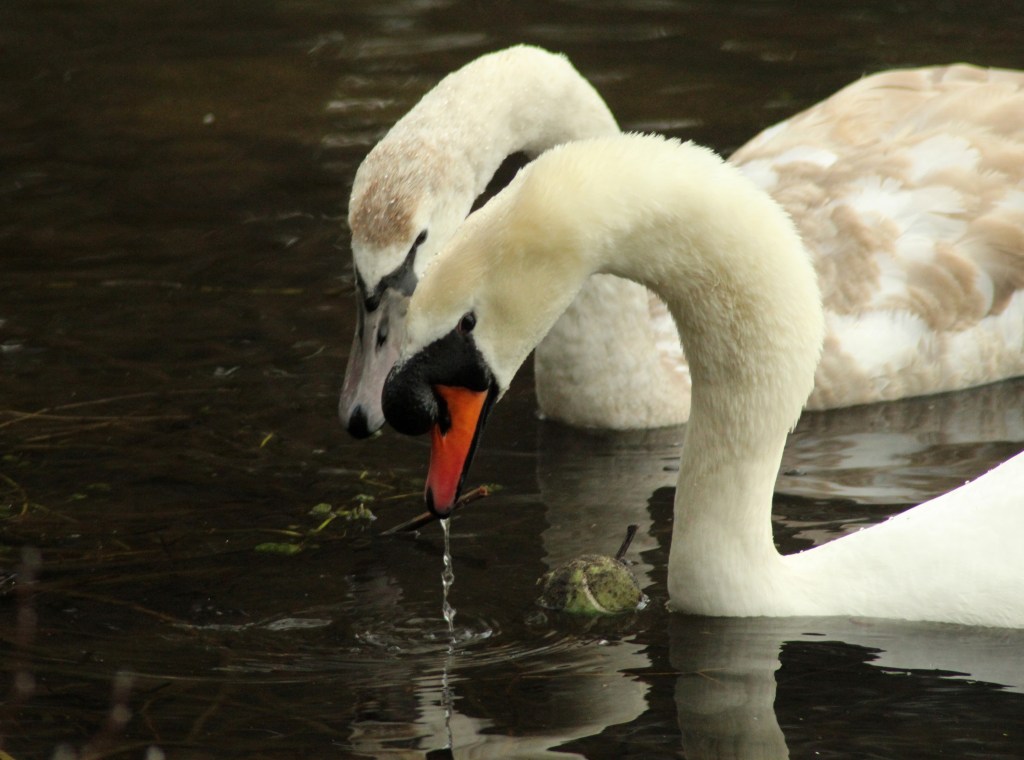
What is it? It’s a mute swan, obviously. Found in most park ponds and lakes in Europe and introduced to North America. Essentially a large white goose with a long neck, orange and black face, and an angry disposition. They do look pretty serene when out on the water, but on the land they come across like a bit of a bully, badgering you for food and making a nuisance. It’s a myth they can break your arm with their wings, but I’m willing to bet they can do damage nevertheless!

A fact I have learned about this species: Their closest living relations are not the migratory swans of the Northern Hemisphere but rather two Southern Hemisphere species; namely the Black Swan Cygnus atratus of Australia and the Black-necked Swan C. melancoryphus of South America.

A male mute swan and a juvenile taken on 28th February 2016 at Poynton Pool, UK (Photo: Alex Cropper)

Is it charismatic in my opinion? It’s large and seems constantly angry, so yes.

Day 15 – Yew

Not a female sheep today but an evergreen shrub/tree. One of the UK’s only native conifer species (the other being the Scot’s Pine) it is a species steeped in history. So without further ado…

What: Yew Taxus baccata L.

When: 15th January 2020

Where: Poynton Pool, Cheshire, UK

Who saw it: Me

How did I record it? On the iRecord app.

Is it bigger than a blackbird? Yes, it’s a shrub, and blackbirds eat the berries.

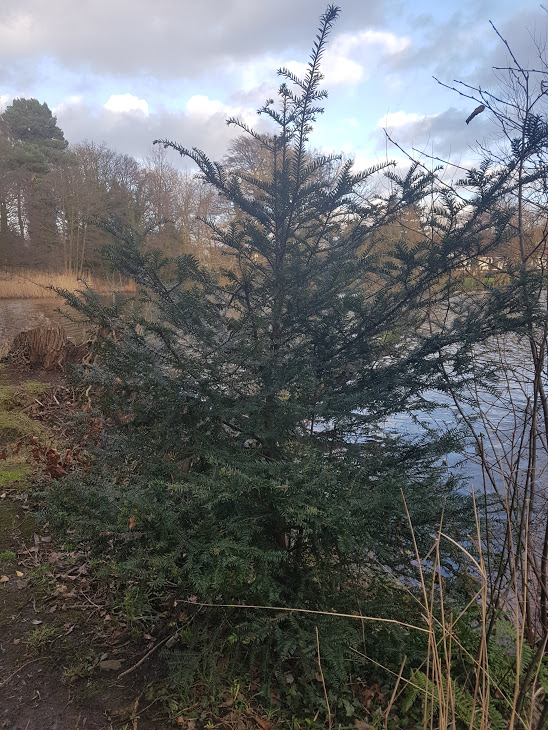
What is it? A shrubby evergreen conifer native to the UK, most of the rest of Europe and the western bit of Asia. The red berries, seen in autumn, are highly toxic to humans and cattle but are a prized food item for birds, thrushes in particular. In Britain old and ancient plants they are primarily associated with churchyards, many of which are as old or older than the church (many churches in Britain are ancient in their own right). There doesn’t seem a consensus as to why the association with churchyards, possibly it comes from folklore where Yews are said to ward off evil spirits, or even from pre-Christian pagan sites, some of which were subsequently built on with churches.

A fact I have learned about this species: I knew this one beforehand but hey… Yew wood was used to make English longbows, one of the fiercest weapons of the medieval era. Another fact is that (possibly) the oldest Yew in the UK is estimated to be between 2,000 and 3,000 years old and resides in a churchyard in Perthshire, Scotland. (Ref:https://www.woodlandtrust.org.uk/blog/2018/01/ancient-yew-trees/)

The young Yew I saw in my local park today (Photo: Alex Cropper)

Is it charismatic? Yes. There is so much history and lore associated with this species it can’t be anything but. Chances are that if you are seeing an ancient yew than you are seeing something that will have been living on this planet when historic events have taken place; Viking Invasion, Norman Invasion, Magna Carta (if it’s truly ancient for the last 3!), the age of Shakespeare, English Civil War, American Independence and many more.

Day 14 – Brown Hare

I’ve done some paid wildlife surveying today! I assisted a local ecological consultants in a site survey for wintering birds. Not many birds to be frank, other than on the adjacent Ribble Estuary so I’ve gone for the highlight of the survey, not a bird but a mammal.

What: Brown Hare Lepus europaeus Pallas 1778

When: 14th January 2020

Where: A site near Preston Docks, Preston, Lancashire, UK

Who saw it? Myself and a work colleague

How was it recorded? Noted down on the site survey, hopefully the record will filter through to the local mammal recorder.

Is it larger than a blackbird? Yes, about the size of a small dog.

What is it? A mammal in the lagomorph family (which includes rabbits). Larger than rabbits they run with their hind legs stretched, unlike the decidedly ‘hoppy’ rabbits. I’m not sure I’ve ever seen one standing still, they always seem to be running. Very wary of humans and skittish as a result; hence all the running. Light brown fur with a short black and white tail on a black and white rump. Crazy mad orange eyes. They don’t live in burrows.

A fact I have learned about this species: ‘Boxing’ hares in the breeding season are not usually two males fighting, rather a female batting away a potential suitor (Couzens et al, 2017).

Visual representation: You’ll have to make one up. I have no picture of my own and it’s far too close to the start of my bar job to do one of my highly accurate Paint special drawings. Imagine a giant rabbit and you’re most of the way there. Or Google them. Actually, yes, Google it!

Are they charismatic? More enigmatic than charismatic. You only ever see them running away. You’re more likely to see droppings or footprints than the individuals themselves. They are also mostly solitary; imagine a lone rider in an old Western or something, you don’t know much about them except by reputation.

Day 13 – Coot

Today Storm Brendan approaches and whilst it won’t be as windy here in North West England as elsewhere (Ireland in particular) it is still a pretty windy day. Nevertheless I’ve managed to get out for a walk around my local park, so I have another species! I’m realising this blog is rather bird heavy at the moment but they are more visable than most other wildlife at this time of year, and I’m more familiar with them than other things; I will endeavor to branch out though.

What: Coot Fulica atra Linnaeus, 1758

When: 13th January 2020

Where: Poynton Pool, Cheshire, UK

Who saw it: Me

How did I record it? On eBird. There was 10 of them today (probably an under-estimate).

Is it bigger than a blackbird? Yes

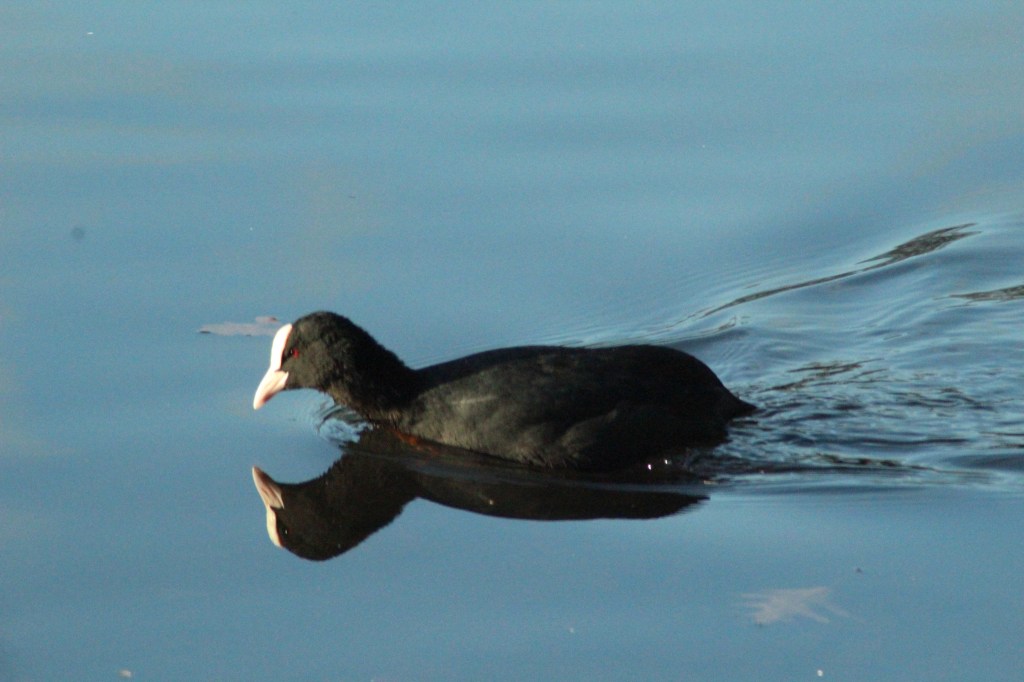
What is it? A rather portly bird in the rail family. Very familiar on ponds and lakes. Swims like a duck but is not a duck. They are black all over with a familiar white crest on their forehead. They can be very aggressive to one another and it’s common to see them fighting; pretty much a daily occurrence with them! They are sometimes seen out of the water grazing on grass when there’s not too much disturbance around. Their feet are really weird looking.

A fact I have learned about this species: They are increasing in number in the UK and my home county of Cheshire seems to be an important region for them with a disproportionate population given the size of the county. (Ref: http://www.cheshireandwirralbirdatlas.org/species/coot-breeding.htm). Cheshire has a lot of ponds and small bodies of water so this would make sense.

Coot at Poynton Pool in November 2019 (Photo: Alex Cropper)

Is it a charismatic in my opinion? Yes. Any bird that is constantly pumped and up for a fight has got to be surely?! They aren’t exactly the best looking bird in the world; their chicks are particularly ugly (at least for waterfowl). But to make up for this they have personality.

Day 12 – Holly Leaf Miner

Today’s species sighting dates from last year but I’ve only just worked out what it is thanks to someone posting a photo the same species in a Facebook group I’m a member of. There seems to be a Facebook group for every niche possible!

What: Holly Leaf Miner Phytomyza ilicis Curtis, 1846

When: 13th November 2019 (although it is still there today)

Where: My garden, Poynton, Cheshire. UK

Who saw it: Me

How did I record it? On iRecord.

Is it larger than a blackbird? No, definitely not!

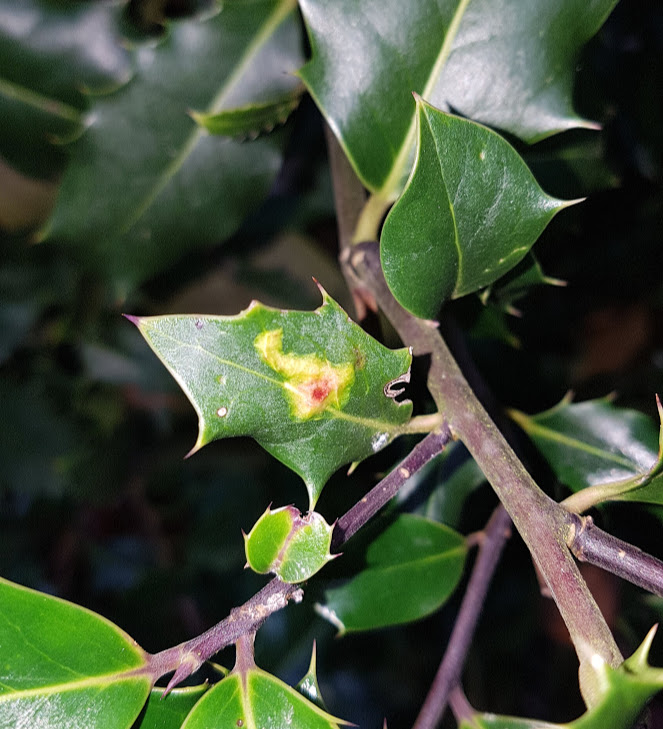
What is it? A tiny fly who’s larvae live inside holly leaves. They make distinctive yellow and red blotches on the leaves. They are pretty common, most holly I’ve seen recently has them.

A fact I have learned about this species: All the facts about this one are new to me, I only knew about the species last week! But, according to Wikipedia the fly has been studied in food web studies as the larvae are frequently parasitised or eaten by birds such as Blue Tits.

Holly leaf-miner mine (the red blotch surrounded by dug out, or rather eaten out, yellow plant material). (Photo: Alex Cropper)

Is it charismatic in my opinion? Probably not, I’ve just looked at a picture of an adult fly (who don’t live in the mines but lay their eggs in holly leaves) and they look like a standard house-fly type fly. There are better looking leaf galls such as the Robin’s Pin-cushion.

Day 11 – Lapwing

Today I’ve been to watch the British Dodgeball Open in Cannock, Staffordshire so I’ve not really been outside. But I did see a few things on the journey down so one of those is today’s subject.

What: (Northern) Lapwing Vanellus vanellus (Linnaeus, 1758)

When: 11th January 2020

Where: Astbury, Cheshire, UK

Who saw it? Me, from the road, a flock of maybe 200 birds (hard to count when I’m driving though!)

How did I record it? Will submit the record on eBird.

Is it bigger than a blackbird? Yes

What is it? A medium sized wading bird of the plover family. It is dark green, black and white in colour with a prominent crest. Their wings are characteristically square although there is a difference between the male wing shape and the female. They are gregarious and seem to be one of those species of birds that fly up without too much provocation; they are incredibly skittish. They are unfortunately declining as a breeding bird in the UK with their preferred habitat of open grassland decreasing, partly due to changing farming practices.

A fact I have learned about this species: Whilst it’s official English name is ‘lapwing’ it is sometimes more commonly known in these parts (Northern England) as the Peewit; named after the bird’s call. The name lapwing comes from the Mercian dialect of Old English; from what is now the English midlands (Lockwood, 1984).

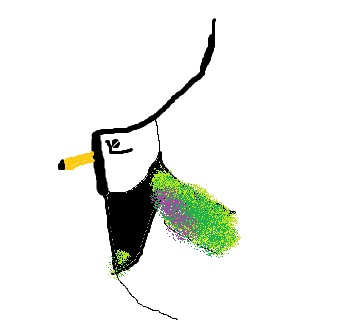
A perfectly accurate drawing of a Lapwing drawn using Paint by your’s truly.

Is it charismatic in my opinion? Maybe, as I said in a previous post any gregarious bird species gets immediate charisma points. However this species almost seems too pathetic and too flighty for it’s own good. They fly up due to who knows what on most occasions and they do have a really needy sounding call. But just look at them (maybe not my drawing!) they are spectacular looking things that are perhaps a little underappreciated. A yes on reflection.

Reference: Lockwood, W. B. (1984) The Oxford Book of British Bird Names Oxford University Press, Oxford

Day 10 – Raven

Today has been a struggle to think about what to write about. Sure there are common birds in the garden I could write about but I’m not sure I want to write about the easier birds too quickly, if I carry this on after the end of this month I’m quickly going to be running out of subjects so it will be handy to have common species as an easy go-to. But about half an hour ago a more unusual bird flew over, I didn’t even see it but the call is so familiar to me I knew instantly what it was. So without further ado..

What: Raven Corvus corax Linnaeus, 1758

When: 10th January 2020

Where: Poynton, Cheshire, UK

Who saw it? Me, heard it in this case.

How did I record it? I haven’t yet, but will record it to eBird.

Is it larger than a blackbird? Yes

What is it? The largest member of the crow family. About the same size as a buzzard. A bird that is increasing in number in the UK. I never remember hearing them in areas such as I live until recently; I only ever saw them in upland areas near to their breeding areas. They have a really deep rasping caw, a bit like a common carrion crow who’s got a heavy cold or trying to do a dog impression; really distinctive once you’ve heard it. They will be beginning to re-establish bonds with partners at this time of year and begin breeding in February, a lot earlier than most species of bird in the UK. They traditionally (thanks to historic persecution) breed in upland and coastal cliffs, but some now breed in lowland areas; including on Jodrell Bank’s Lovell Telescope ( http://www.cheshireandwirralbirdatlas.org/species/raven-breeding.htm )

A fact I have learned about this species: The name ‘raven’ is one of the earliest known bird names in the English language dating back to the Old English hrӕfn (Old English was language spoken in England before the Norman conquest, a meld of Old Germanic languages and old Norse – the two people who invaded and colonised after the Romans left). The pronunciation may even go back further than Old English (even older than Old High German, and Old Norse too) dating back to an unknown pre-Germanic language. (Lockwood, 1984).

A visual representation: There isn’t one today, not got enough time to draw anything. Just imagine a carrion crow (or a hooded one if they are more familiar to you) and double it’s size.

Is it charismatic? Yes. All corvids (birds of the crow family) are so intelligent that they can’t be anything else other than charismatic. Imagine if Long-John Silver had a Raven instead of a parrot on his shoulder, he would certainly have been a more successful pirate! There is so much folklore surrounding this bird there could be books and books written about it (there probably are!).

Ref: Lockwood, W. B. (1984) The Oxford Book of British Bird Names Oxford University Press, Oxford

Design a site like this with WordPress.com
Get started