38. Garden Snail

I’m toying with the idea to go back to one species a day. It’s good for the mind and gets me out looking for things; and will give me a challenge to write about things I don’t know much about. But, if i’m busy with work with no chance to get something down then I’m not going to be too harsh on myself if I miss a day. But I will see. I’ve done seven species since my one per day in January ended, so not too great if I’m honest. For today’s I’ve quickly gone round the front of my house as it’s warmer and more sheltered from the incessant terrible weather (not too bad today bar the wind) to try and find some of my 2nd love in nature (after birds) which are insects. Alas no, still too cold and windy, but I did find the remains of another invertebrate beneath a plant pot…

What: Common Garden Snail Cornu aspersum (A.F. Müller, 1774)

When: 1st March 2020

Where: My garden, Poynton, Cheshire, UK

Who saw it? Me

How was it recorded? Using the iRecord app. (https://www.brc.ac.uk/irecord/home)

Is it bigger than a blackbird? No, blackbird’s cousins the song thrushes eat them.

What is it? The stereotypical (in the UK at least) garden snail. A mottled brown shell housing a slug-like mollusc. The Common Garden Snail is a relatively large terrestrial snail in Britain. It is mostly nocturnal. They also hibernate over winter in secluded spots, such as under my plant pots (although the one I recorded is no longer with us, the shell had been drilled into and the animal had gone leaving behind just the shell). Unbelievably (too me, I’ve just found this out) they are a non-native species in Britain, indeed the snail ID book I have (yes, I have one! I have ID books for most types of creature) says it is ‘common in the south and on the cast and spreading rapidly inland’ (Cameron, 2008) but this must be way out of date as I live in the north of England and I’ve been seeing them all of my life. Ref: Cameron, R. (2008) Land Snails in the British Isles (2nd edition) FSC, Shrewsbury

A fact I have learned about this species: Apart from their non-native status stated above I have found out that they are edible and some folks farm them for food in the UK (according to the chronicle that is Wikipedia).
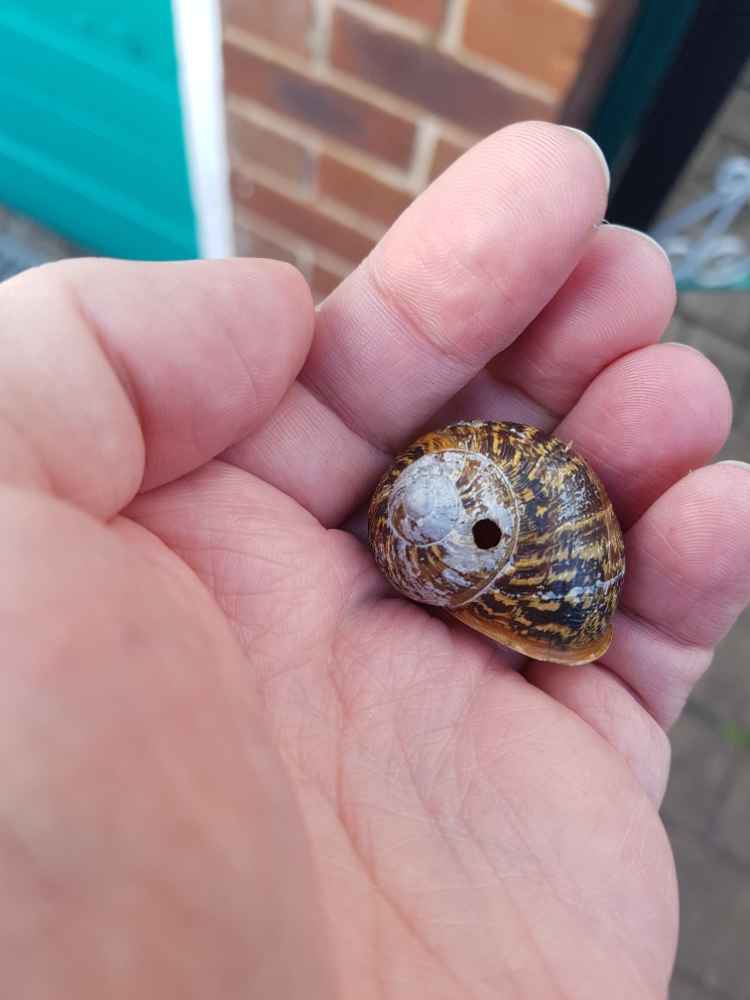
This shell I saw this afternoon seems to have been drilled out by a predator of some description (Photo: Alex Cropper)

Is it charismatic in my opinion? Erm, maybe. When it is damp and dark I often walk home from work in the middle of the road (I live on a quiet road!) to avoid standing on them. I also pick them up and throw them over the wall if they are in danger of being ran over. No idea why, don’t do it for slugs. Something about them (not just this species, all snails) that may make them charismatic. Plus gardeners hate them, so anything that irritates humans directly must have some degree of charisma?
37. Blackcap

After my last post about a common garden plant (read by literally no one!) I’ll go back to a bird. And maybe a bird that is a unique migrant, as this bird is not only a spring migrant, ie: one that migrates to here to breed from warmer climates, but is also a autumn and winter migrant, so one that migrates here from colder climates. Most migrants are one or the other, this is both. And one turned up in my garden this morning as a winter visitor.

What: Blackcap Sylvia atricapilla (Linnaeus, 1758)

When: 26th February 2020

Where: My garden, Poynton, Cheshire, UK

Who saw it? Me

How did I record it? Using the eBird app.

Is it bigger than a blackbird? No. About the same size as a house sparrow.

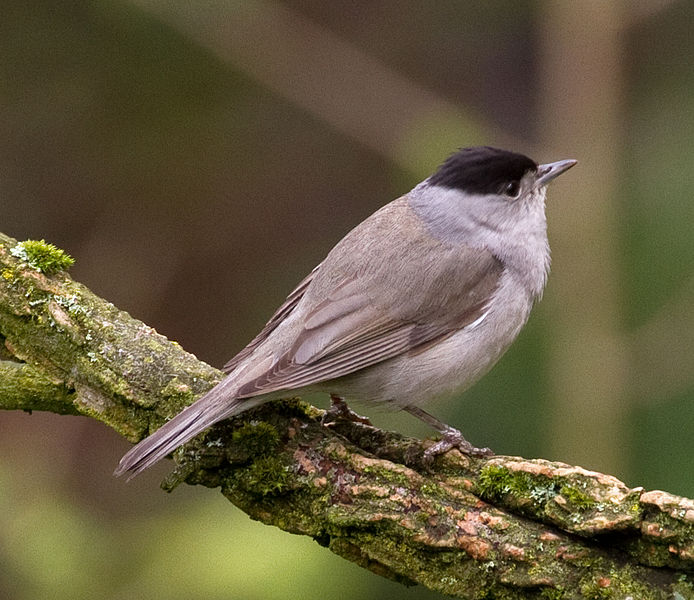
What is it? A small brown bird in the warbler family. As the English name suggests it has a black top half of its head, or at least the male does; the female has a tawny-brown one. As I said in the description it is both a winter and spring visitor, but is more commonly known in the UK as a spring migrant with the majority of the birds arriving in mid-April. So how come I saw one today? The winter birds, studies have shown, come to the UK from Germany. The reason? Bird feeders. Even though the German birds would stand a better chance of winter survival in the Mediterranean or sub-Saharan Africa; where most birds over winter, they take a chance at surviving on bird feeder seeds which provide less sustenance than their preferred invertebrates.. The reason being is that when they return to Germany, the birds that have successfully overwintered in the UK will have a better chance at claiming breeding territory before the African over-winterers return. I may write another blog for the Blackcap when ‘our birds’ return to the UK in Spring.

A fact I have learned about this species: It’s song is so varied and rich in springtime the bird sometimes gets called the ‘mock nightingale.’

A male blackcap (Photo: Tony Hisgett via Wiki Commons)

Is it charismatic in my opinion? Enigmatic at this time of the year, even though they specifically migrate here in winter to feed on our bird feeders I very rarely see one using them. They are way more charismatic in spring when they begin to sing.

36. Daisy

Need to do a 2nd blog this week! It’s raining, I’ve done loads of other tasks, my cat is playing up (near his dinner time) and I need to write a blog else I will fall behind! But what to write about? I’ve been cooped up inside all day and indeed most of the week. I look out onto the sodden and water-logged front garden and there it is, poking through the grass in a forlorn hope of attracting a bee…

What: Daisy Bellis perennis L.

When: 21st February 2020 (although I’ve been seeing it for a few weeks)

Where: My front garden, Poynton, Cheshire (VC58), UK

Who saw it? Me (although my dad pointed this particular plant out to me last week)

How was it recorded? I haven’t but I recorded another individual for my New Year Plant Hunt (see post 3 [I think])

Is it bigger than a blackbird? No, it lives on a lawn, probably being trampled by blackbirds on a daily basis.

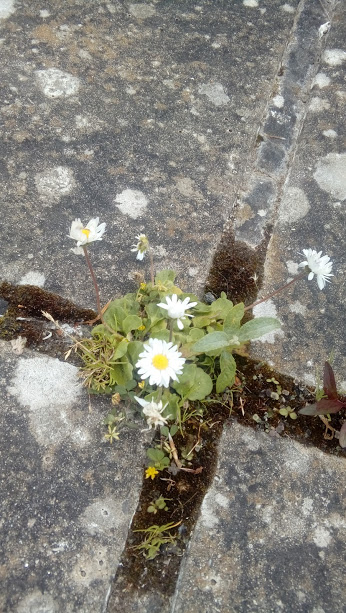
What is it? A daisy. Not much more to say, everyone knows what one is! They are probably the most familiar plant in the UK (and probably elsewhere in Europe), and have been introduced elsewhere outside of Europe. They have to be the flower everyone thinks of automatically when picturing a wildflower, and they must be the first flower that people learn the name of, probably well before school age. For those that don’t know, the daisy has white ‘petals’ (not strictly petals at all) and a bright yellow interior. They are mostly prostrate (ie: live close to the ground) and live on most short cut lawns as well as more wild short grassland. Whilst there are hundreds of species in the broader daisy family there can only be one actual daisy surely?

A fact I have learned about this species? One I already know but others may not; the yellow interior of a daisy flower is actually made up of many smaller individual flowers which together make up the whole ‘flower’ head (All members of the daisy family share this trait).

A visualisation: Look at a child’s drawing, there’ll be one there somewhere!

It’s a daisy, this one growing between paving slabs (Photo: Alex Cropper)

Is it charismatic in my opinion? I may be being controversial by saying no. They’re kind of just there aren’t they? I know they are probably the most well known plant in the country and kids play with them but still there are nicer lawn plants (dare I say a buttercup?). They look a bit like bedraggled ballet dancers in my opinion. But they are beloved by lots of people.

35. Blackbird

As we sit on the precipice of Spring nature is beginning to stir. Although it very much feels like us humans in the UK are still in Winter’s grip (a pretty weak and warm grip truth be told these days) with named storms every weekend and unnamed (it seems) in between. The daylight is getting longer, but interesting things to write about are still asleep. Then this morning a blackbird sang.

What: Blackbird Turdus merula Linnaeus, 1758

When: 18th February 2020

Where: Outside my house, Poynton, Cheshire, UK.

Who saw it? Me (heard it, although I’ve seen a non-singing one subsequently)

How did I record it? On eBird.

Is it bigger than a blackbird? It is a blackbird.

What is it? A very familiar garden bird in the UK and the rest of Europe and much of Asia. The males give the species their English name as they are coal black with a bright yellow bill and yellow ring around its eye. The females are dark brown in colour with sometimes a slight spotty appearance. At this time of year the males begin to sing and it is the true sound of spring and summer, they stop singing in about July time along with most other song birds. A fluting melodic noise which is so iconic. The Beatles once had one singing on a song (Blackbird, obviously…).

A fact I have learned about this species: It is known as “Druid Dhubh” in Scottish Gaelic. Dhubh is pronounced as dove I’m guessing?

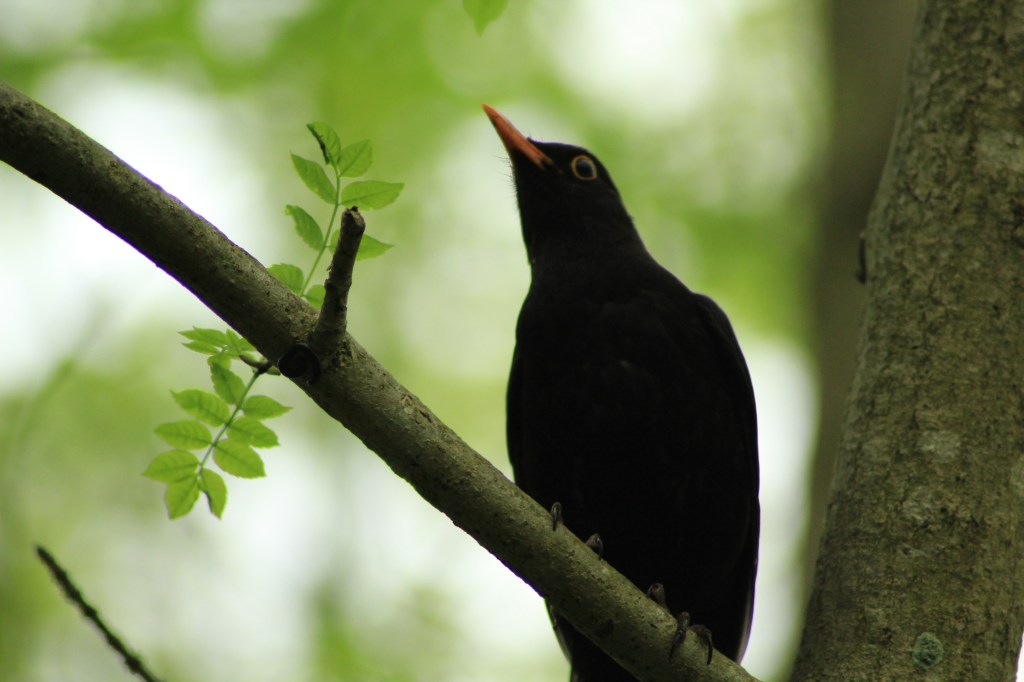
A male blackbird I photographed in Derbyshire in 2015 (Photo: Alex Cropper)

Is it charismatic in my opinion? Yes definitely. The easiest decision I’ve made for this section! The song, the looks, the fact they hop around in gardens, they nest in your hedge, or your shed, or wherever they fancy really. I once heard a blackbird which almost sounded like it was singing a cover of “Peaches” by the Stranglers. Definitely, 100%, charismatic.

eBird app Overview

Something different today. To record my bird sightings around my patch (and elsewhere) I use an app called eBird. This provides a quick convenient way of logging species and numbers of birds whilst on your walk.

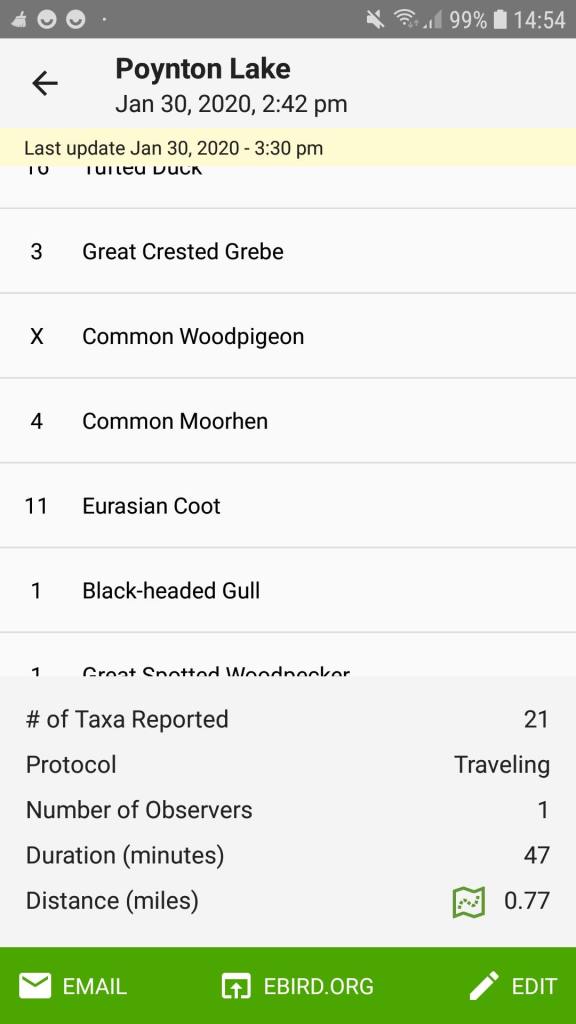
Basically, when I get to a site I can select it using the app (or it automatically selects a lat/longitude position using your phone’s GPS) and it brings up a list of birds you will likely see in the area, based on previous users entries. The first flaw begins here as this list is based on a 20km radius of where you are, so some birds at your site will be listed as common when they are anything but, and some birds are listed as unusual when they are there all the time. This is further complicated when the auto-list considers the time of year, again based on previous data. The app uses a traffic light system, green birds you will see all the time, amber birds are unusual but not overly so, and red birds won’t have been seen at the site at that time of year, or at all. Currently Great-crested Grebes are listed as amber for my site even though they are an ever present, probably as they may be under-recorded or rare elsewhere in a 20km radius. It generally works though and the amber only provides an opportunity to think twice about what you are entering (a red would require an additional report with further evidence).

A screenshot of a recent visit to my patch. (eBird v2.0.8, Cornell Labs, 2020)

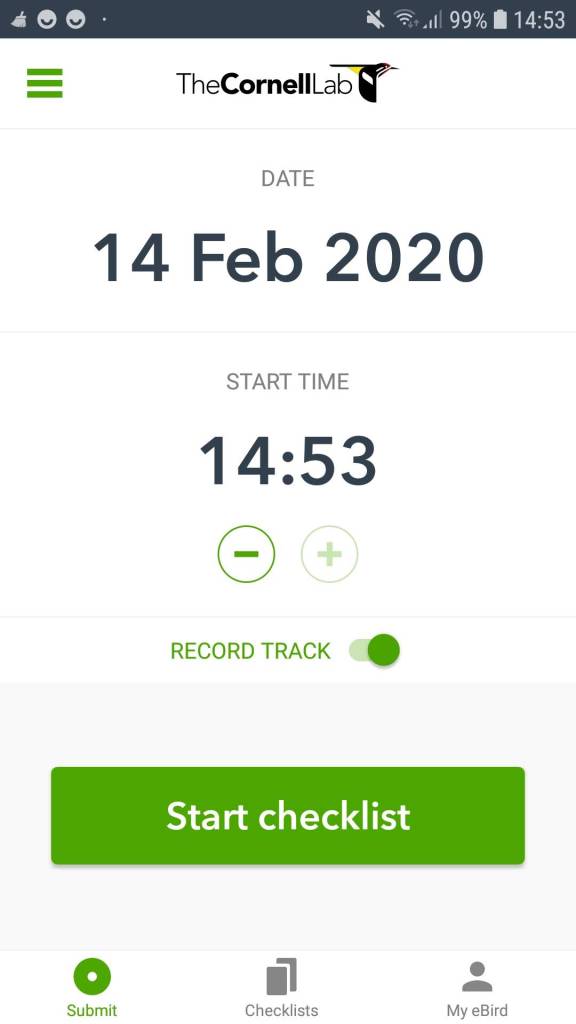
The best feature of the app is the tracker system, which follows your walk in real time. This may sound slightly pointless but is in fact a great way to record effort. If you walk a mile and take 10 minutes you won’t really have seen much, if you take an hour than chances are you have seen most birds on your journey. Great, unfortunately it doesn’t work too often. Phone apps by there nature should still run in the background when the phone sleeps in your pocket or you take a call or whatever. Most of the time eBird does but occasionally (and increasingly so) it sometimes “restarts” the trip timer, at which point the tracker stops. You get to the end of your session, confirm your data, and find the app thinks you’ve only walked a few yards rather than a mile, despite having bird-watched for over an hour. A minor inconvenience as you can edit the distance manually, but it won’t be as accurate (also frustrating as I know I’ve walked a mile and I have no independent way of proving this, I hope fitbits don’t have this issue!).

I did have previous concerns about the end data not reaching the local recorder (who would handle the data and make it useful for others, if someone one day want to drain my local lake, the gathered bird data I and others have gathered should influence the decision providing someone else knows about it), however the data is availble to them, but not directly unlike another app ‘BirdTrack’ whose data goes direct to the recorders; I find the app to be a bit clunky though for my purposes.

After I have finished and sent my data off I can see my data on the eBird website. If the site is a designated ‘Hotspot’ – where a number of users go. Then you can compare your data to other birders and compare it historically, year to year, month to month. This is where eBird really wins in my opinion.

I would recommend it to anyone who goes birdwatching regularly, it’s easy to use and easy to see your results, and it’s technical flaws, whilst annoying don’t seem to affect data quality too much.

The screen you see before you begin recording, including the ability to switch the occasionally flawed record track off. (eBird v2.0.8, Cornell Labs, 2020)

34. Tufted Duck

This two posts a week thing is going well isn’t it?! My focus definitely lapses when it’s not an every day commitment, I knew this would happen! Anyway, I’m writing one now and in fairness the weather since my last post in the UK has been pretty awful, Storm Ciara hit followed by a couple of extra days of high winds and lots of rain. I’ll write another post tomorrow to get me back on track! On to today’s species, a bird. Again. One that frequents my local patch during most of the autumn and winter in moderate but consistent numbers. A pleasant change from the usual park lake mallards that frequent every pond and lake in the entire world it seems.

What: Tufted Duck Aythya fuligula (Linnaeus, 1758)

When: 12th February 2020

Where: Poynton Pool, Cheshire, UK.

Who saw it: Me

How did I record it? Using the eBird app.

Is it bigger than a blackbird? Yes, about the same size as a mallard duck.

What is it? A common diving duck. Diving ducks feed by diving under the water surface to find food, unlike dabbling ducks which feed from the surface. They are increasing in number during the winter and more birds are breeding here in the spring and summer (Balmer et al, 2013). However, they don’t seem to breed in my local lake. The males look black and white from a distance but the dark colour is almost a shiny midnight blue or purple in the right light. The females, like most ducks, are brown, but in this species they are two-tone brown, the upper body a dark brown and the lower (the “hull” if it were a boat) is light brown. Both sexes have a tufted crest on their heads but these aren’t always prominent. They seem to spend most of their existence in the water; i’ve never seen them on the land. Ref: Balmer et al (2013) Bird Atlas 2007-11: The breeding and wintering birds of Britain and Ireland BTO Books, Thetford

A fact I have learned about this species: There are 18,000 pairs breeding in the UK (source: https://app.bto.org/birdfacts/results/bob2030.htm).

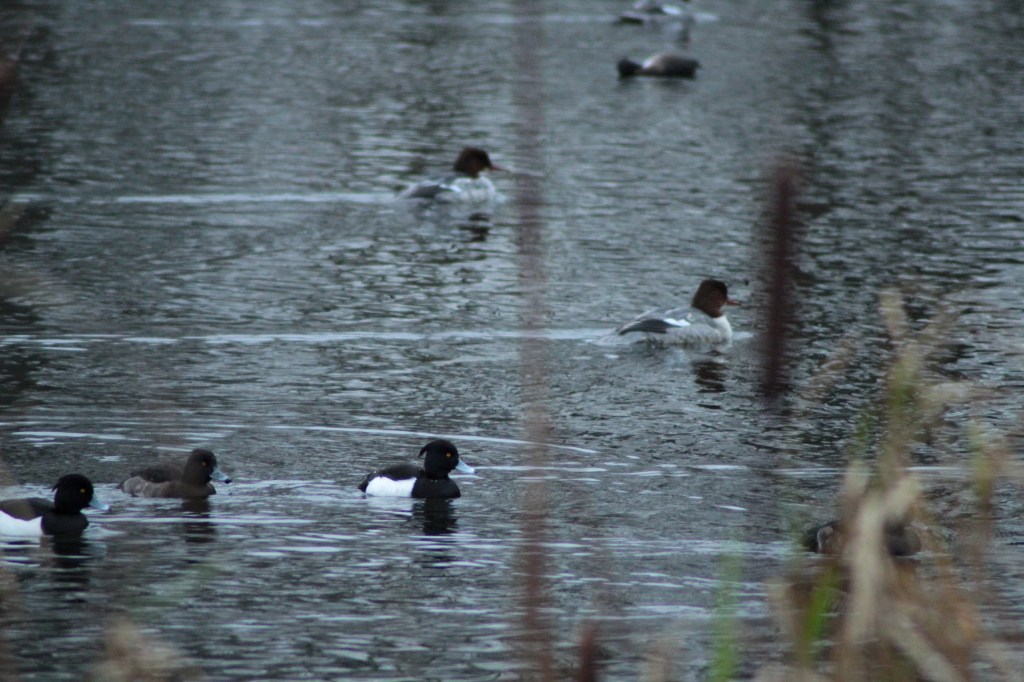
Not my finest photo! Three tufted ducks at my local park a few years ago, along with a couple of goosanders (Photo: Alex Cropper)

Are they charismatic in my opinion? I think all ducks are aren’t they? These, unlike mallards and other park water fowl, they aren’t bothered by bread; a mallard can sense a bag of breadcrumbs being opened from several miles away it seems! Tufties will just stay in the middle of the lake and just keep diving (which makes them a pain to count by the way!) whilst the mallards fight to the death for the last breadcrumb.

33. Buzzard

A quick blast around the local nature reserve this afternoon, the wind is really picking up so didn’t spend too long there; tomorrow Storm Ciara hits these islands so it’s going to be mega windy tomorrow! (As an aside, the islands of Ireland and Britain have had named storms for a few years now, and it has made me far more aware of impending bad storms than beforehand – and I can now pronounce Irish names better as a side effect, I would have said “kee-ara” before rather than “keera” as it should be). There was more activity than I thought there may be, including some Bird of Prey action.

What: Buzzard Buteo buteo (Linnaeus, 1758)

When: 8th February 2020

Where: Poynton, Cheshire, UK (being deliberately vague here)

Who saw it? Me

How was it recorded? On the eBird app.

Is it bigger than a blackbird? Yes.

What is it? A fairly large bird of prey in the accipiter family. They are one of the commonest birds of prey in the UK, but unlike the equally common sparrowhawk (from a couple of posts ago) are way more obvious and spend a lot of time soaring on the wing. They are very vocal for birds of prey too, their distinctive “kee-aww” call is a big clue to their presence. They are mostly brown in colour with patches of white, especially under the wings. However, they are very variable in their appearance, with many birds considerably lighter, and some a lot darker. I heard once that in Britain at least that pale birds are more common in the south, getting darker and darker as you get further north. I’m not sure how true this is. Unlike falcons, they have broad rounded wings. They are often mistaken for eagles in Scotland where they are disparagingly referred to as ‘tourist eagles’. They are pretty lazy and slow moving for a bird of prey but their main food are rabbits, but will eat carrion and even earthworms.

A fact I have learned about this species: I once did a study on this species so I know a fair bit so there’s not a lot new to be found out (without going highly detailed!). But one thing I learned recently is that they are more closely related to many American birds of prey than European. Most ‘hawks’ in North America are actually species of buzzard (or is it our buzzard is really a species of hawk?!).

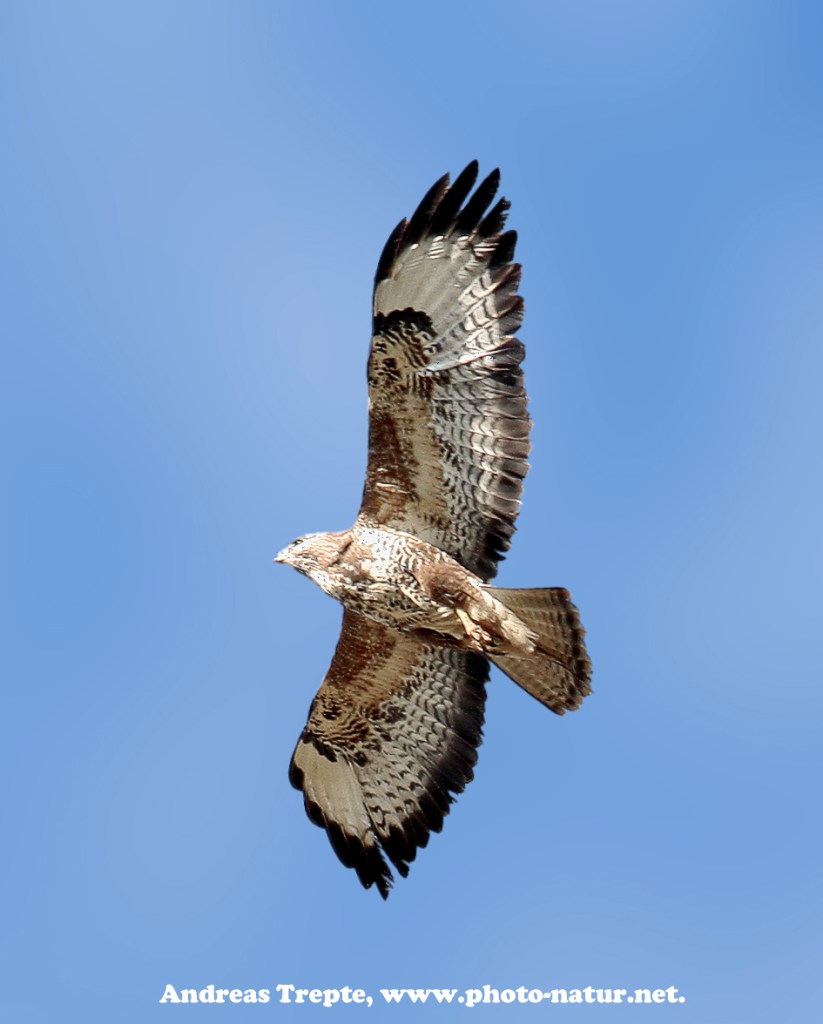
Alas not my pic (I find birds soaring particularly difficult to photograph) (Photo: Andreas Trepte)

Are they charismatic in my opinion? Yes. I think buzzards are one of my favourite birds. I never ever saw them as a child and have only known them in adult life, the reason is they have bounced back from persecution in a big way (although they still are illegally persecuted unfortunately). If I see a buzzard I will always watch it through my binoculars, something I don’t do with many common birds. I love the call, I love that they are incredibly vocal and they always bring a smile to me when I see them.

32. Marsh-marigold

The first post of my scaled back blog. Today’s post is about a plant which is in flower unseasonably early. It should normally be in flower at the end of this month, not the beginning, in fact I saw another example at another site in flower on the 2nd of January. The weather in my part of the UK has been unseasonably mild for a long time, it honestly feels like mid to late March rather than the end of January/beginning of February, and this early flowering is a direct example of this.

What: Marsh-marigold Caltha palustris L.

When: 4th February 2020

Where: Poynton Pool, Cheshire (VC58), UK

Who saw it? Me

How was it recorded? On the iRecord app.

Is it bigger than a blackbird? Hard to tell, just about yes i’d say.

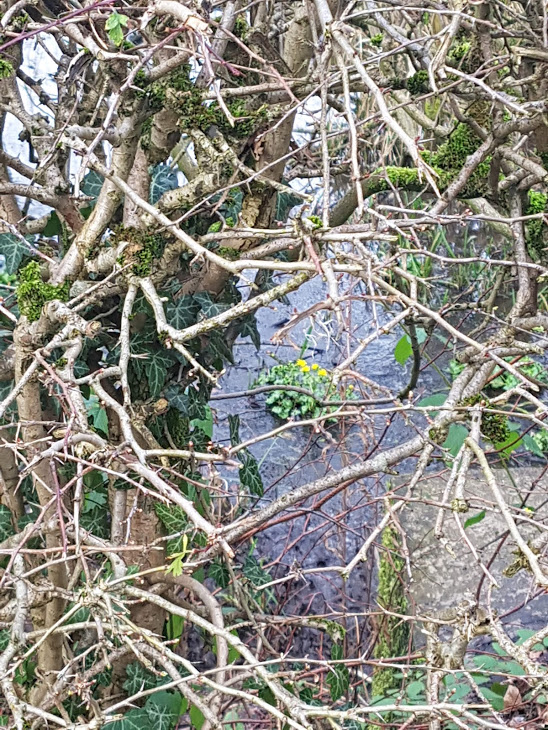
What is it? A member of the buttercup (Rannunculus) family which lives in shallow water and boggy ground; areas of seepage are particularly commonly used. It normally flowers in late winter through to mid-spring in my part of the world. The flowers are typical of the buttercup family, bright yellow in colour but larger in size than common terrestrial buttercups. They are an important source of pollen and nectar for many insect species.

A fact I have learned about this species: They are also known in English as Kingcups.

Is it charismatic in my opinion? As ever it’s hard to tell with a plant, they don’t really do much in all honesty to warrant any charisma. But it seems to be turning into a bell-weather type plant, one that seems to be reflecting our ever-changing climate. A few years ago it was one of my classic signs of spring, but it can no longer be, it flowers throughout winter now seemingly.

Day 31 – Sparrowhawk

So this is it. My final blog of my species a day challenge for January! I think what I will do from now on is do twice weekly posts with maybe some non-sightings posts about wildlife recording in general. I may go back to one a day in another month. I really wanted to do a Bird of Prey (or raptor as they are also known collectively) for my last one as they are my favourite types of bird, but it required me to see one as I’ve not seen one for a while. Luckily I had a choice of three today, a Common Buzzard flew over my house earlier and when out and about I saw a hunting Kestrel and two females of today’s subject.

What: (Eurasian) Sparrowhawk Accipiter nisus (Linnaeus, 1758)

When: 31st January 2020

Where: Jackson’s Brickworks Local Nature Reserve, Cheshire, UK

Who saw it? Me

How was it recorded? On the eBird app.

Is it bigger than a blackbird? Yes, although they are relatively small for a hawk.

What is it? A bird of prey in the Accipitridae family which also includes buzzards, eagles, kites and harriers (but not falcons). Like many small Birds of Prey there is a marked sized difference between the male and female, with the males being small and hunting sparrows, tits, and finches etc and the females being larger and hunting thrushes and starling sized birds. They are one of the commonest bird of prey in the UK but are always elusive; but they will be one of the only birds of prey seen in suburban gardens (usually after a kill). The population (like all raptors) crashed in the 1950s due to insecticides strengthening up the food chain and ultimately weakening eggs. After these were banned the population recovered.

A fact I have learned about this species: All small birds were once known colloquially as ‘sparrows’ (not just house and tree sparrows). And as the male of this species hunts small birds it became known as the sparrowhawk (or in Old English – pre-Norman Conquest English, spearhafoc). Ref: Lockwood, W. B. (1984) The Oxford Book of British Bird Names Oxford University Press, Oxford

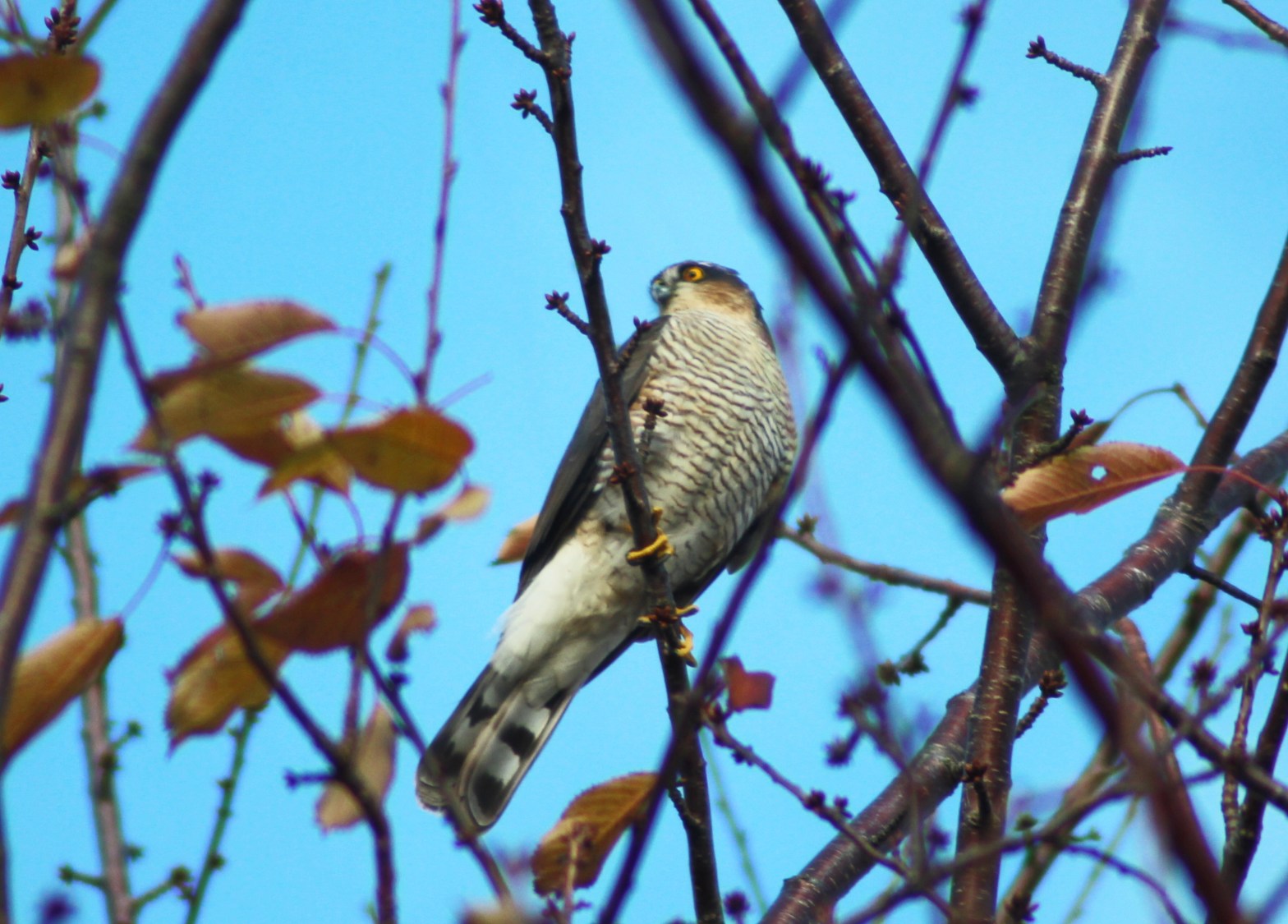
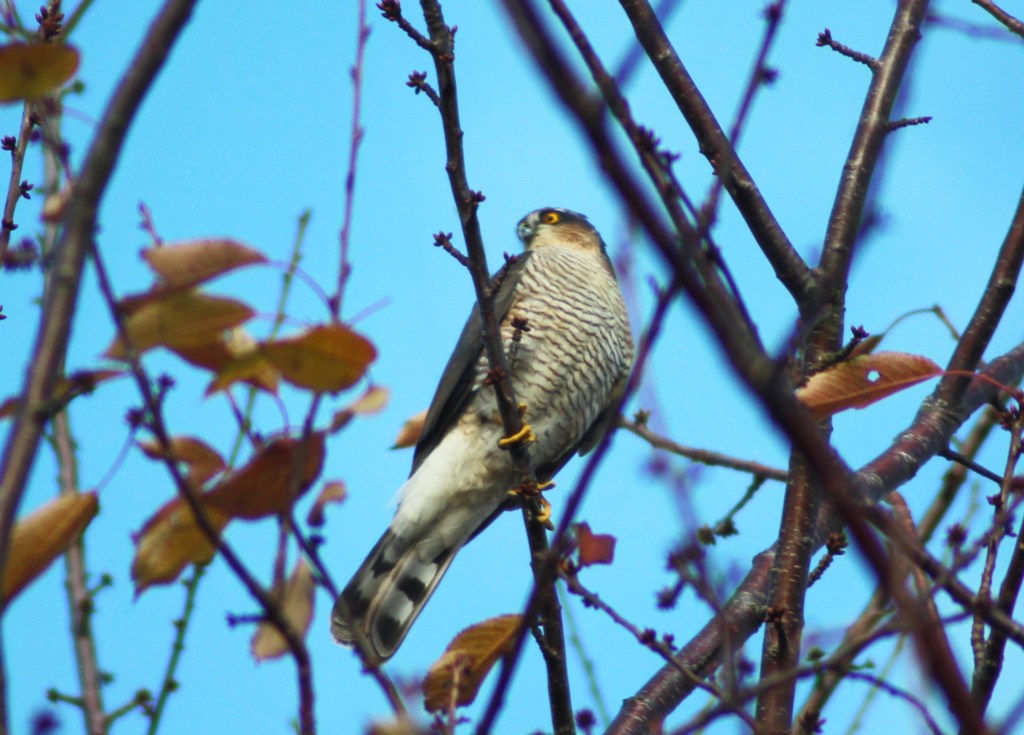
A sparrowhawk in my garden a few years ago (Photo: Alex Cropper)

Is it charismatic in my opinion? I’d say enigmatic rather than charismatic as you very rarely see them even though they are relatively common. You normally just get a flash of a bird as it passes between hedges. Occasionally they’ll take a bird in the garden and then you’ll get a good view, but normally blink and you’ll miss it. They are loud and obnoxious compared to their uber-elusive cousin the Goshawk however.

Day 30 – Lime Tree

The penultimate blog post of my species a day challenge for January. I’m in two minds what to do after tomorrow, to continue writing one every day or to make it twice a week. The issue with every day is running out of things to write about, and that will invaraibly mean writing about more and more obscure things which would need more research, which means more time. I’m liking that it’s a quick process right now but it soon won’t be. On the other side I can easily slip from writing two a week to none at all, I know how my scatterbrained mind works! Any suggestions are welcome.

Today’s species is an amalgamation as I’m not sure on the identification, there is an avenue of trees in my local park which are veteran and ancient in their makeup (ancient are ‘remarkably old for the species’ and veterans are slightly younger). There are two types which were planted centuries ago; Small-leaved Lime and Common Lime. The former are commoner and the latter rare, but were commonly planted in parks.

What: Lime Tilia sp. L. (sp. means “a species”)

When: 30th January 2020

Where: Poynton Park, Poynton, Cheshire, UK

Who saw it? Me

How was it recorded? I haven’t, but two of the avenue are on the Ancient Tree Inventory https://ati.woodlandtrust.org.uk/

Is it bigger than a blackbird? Well obviously, they’re huge trees which can hold many blackbirds!

What is it? (I’ll focus on the small leaved lime Tilia cordata as it’s more ‘wild’) A large deciduous tree with heart shaped leaves. Are thought to be the amongst the first deciduous trees to colonise the British Isles after the end of the last ice age when the islands were still connected physically to mainland Europe. Occasionally known as Linden trees. They are not related to the citrus limes. They host numerous insect species which depend on them for food and shelter.

A fact I have learned about this species: The lime is a sacred tree in Slavic mythology. (https://www.woodlandtrust.org.uk/trees-woods-and-wildlife/british-trees/a-z-of-british-trees/small-leaved-lime/)

The Avenue of Limes at Poynton Park (Photo: Alex Cropper)

Is it charismatic in my opinion? Yes, trees are amazing. Old trees even more so. They host so much wildlife and will have witnessed so much, they were here before us and hopefully will be here long after us as well.

Design a site like this with WordPress.com
Get started