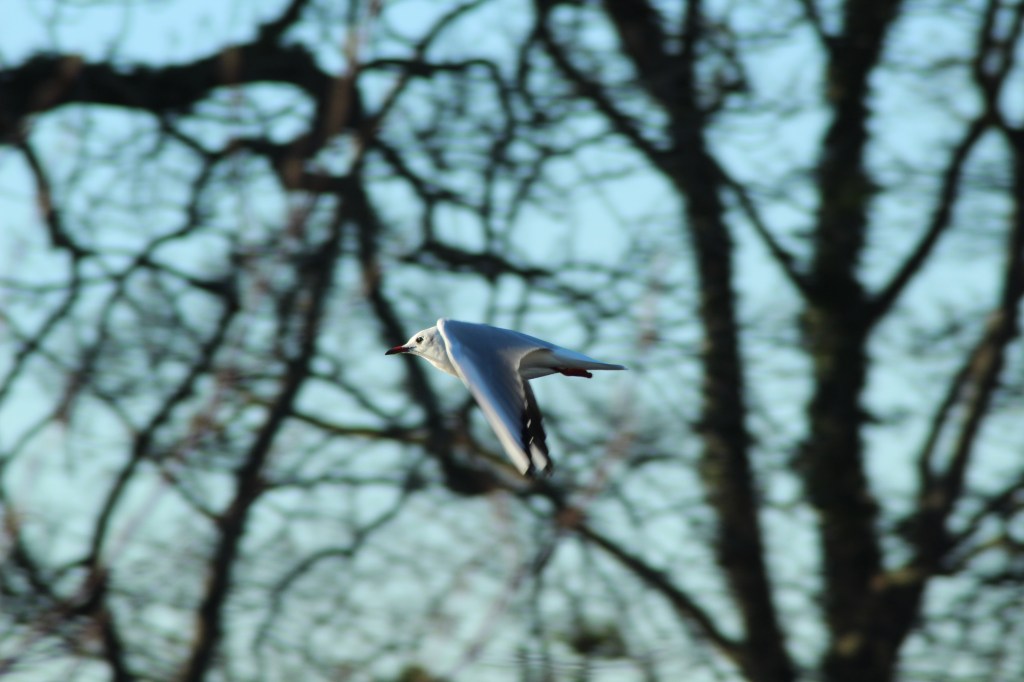
Advent Species No.13

December 13th

I’ve actually been out and surveyed wildlife today! And the weather was terrible! Once a month I have a regular survey (okay, I’ve done it twice, but it will be regular!) where I count waterbirds on a local stretch of water. My bit of water is a small reservoir a few miles down the road, I think it serves the nearby canal as a source of water. Anyway, there were a modest amount of birds their and the subject of today’s advent window type post.

Kingfisher Alcedo atthis (Linnaeus, 1758)

Everyone knows what a kingfisher looks like right? At least my UK readers will, we only have one species here and it is spectacular, electric blue with a turquoise streak on its back and a bright orange breast. Pretty small so they can be illusive despite their bright colours. In other parts of the world their are different kingfishers, bigger ones and ones with different colours, but as far as I’m concerned there’s only one kingfisher.
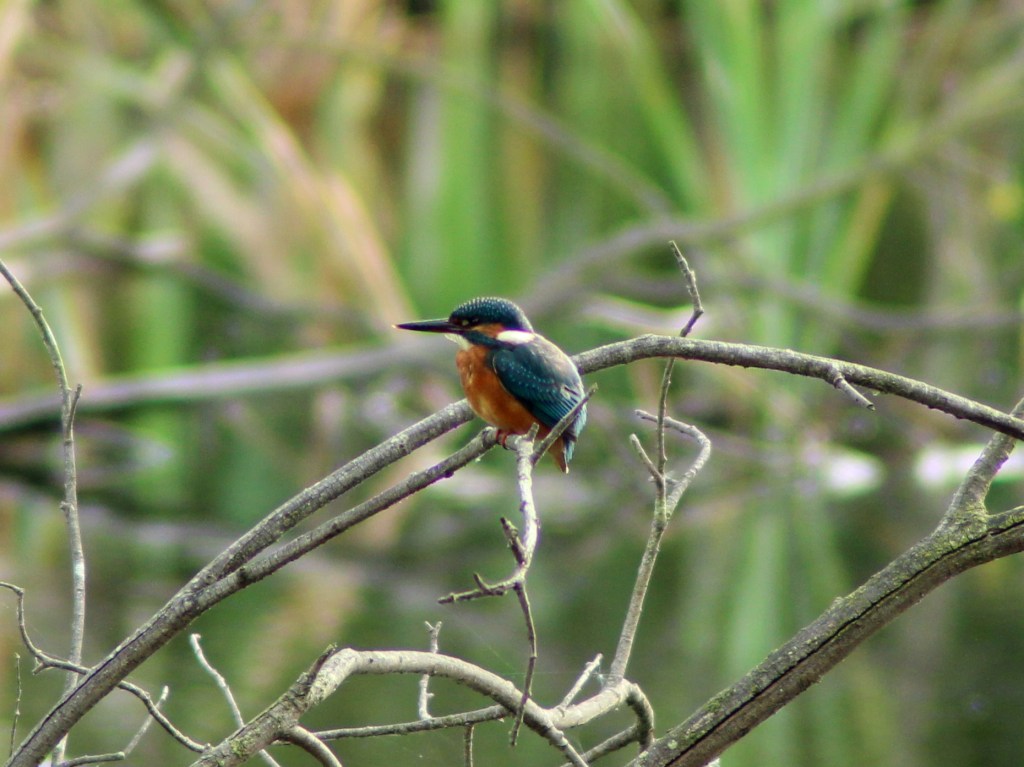
It’s a Kingfisher. Look at it! This isn’t today’s but one I photographed a few years ago at another local site (Photo: Alex Cropper)

Advent species so far:

  • 1st: Goosander Mergus merganser
  • 2nd: December Moth Poecilocampa populi
  • 3rd: Horse Chestnut Aesculus hippocastanum
  • 4th Black-headed Gull Chroicocephalus ridibundus
  • 5th Cape Sparrow Passer melanurus
  • 6th Loricera pilicornis
  • 7th Great Tit Parus major
  • 8th Tipula paludosa
  • 9th Redwing Turdus iliacus
  • 10th Bank Vole Myodes glareolus
  • 11th Tawny Owl Strix aluco
  • 12th Sparrowhawk Accipiter nisus
  • 13th Kingfisher Alcedo atthis

Advent Species No.12

12th December

It’s a species that I’ve already posted about back in January. But, one turned up and landed in the cherry tree and provided such a good view that I couldn’t not feature it (if that makes grammatical sense!). And oh yes, I’m at the half way point!

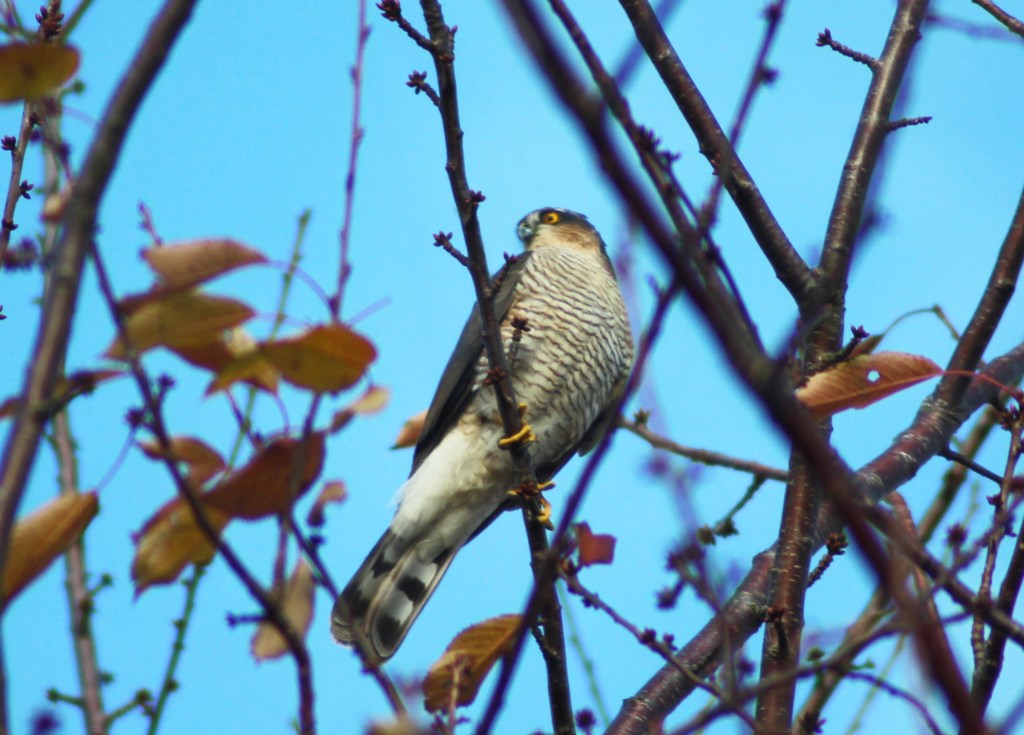
Sparrowhawk Accipiter nisus (Linnaeus, 1758)

Today’s bird was a lady sparrowhawk (or ‘sprawk’) who seemed to be minding her own business and was happy to sit in a couple of branches for a few minutes before leaving. Of course all the other birds in the garden scarpered bar a jackdaw. Corvids have a strange habit of chasing after and mobbing birds of prey, even if the bird of prey is no threat to it, I’m sure a female sprawk could probably hunt a jackdaw, but jackdaws also mob kestrels and buzzards who pose no threat. Female sprawks are bigger than males and hunt bigger birds. A male would go for sparrow sized birds whereas females would go for thrush sized birds. Confusingly, the bird in the photo below is a male (I could juts search for a Wiki Commons image as I often do but I have my own picture. And it’s sitting in the very same cherry tree!). You will see that the male has grey/blue colouring whereas the females are brown.

A male sparrowhawk sitting in the same cherry tree as today’s female bird (Photo: Alex Cropper)
  • 1st: Goosander Mergus merganser
  • 2nd: December Moth Poecilocampa populi
  • 3rd: Horse Chestnut Aesculus hippocastanum
  • 4th Black-headed Gull Chroicocephalus ridibundus
  • 5th Cape Sparrow Passer melanurus
  • 6th Loricera pilicornis
  • 7th Great Tit Parus major
  • 8th Tipula paludosa
  • 9th Redwing Turdus iliacus
  • 10th Bank Vole Myodes glareolus
  • 11th Tawny Owl Strix aluco
  • 12th Sparrowhawk Accipiter nisus

Advent Species No.11

11th December

A nocturnal species for a post written at night. No more preamble today!

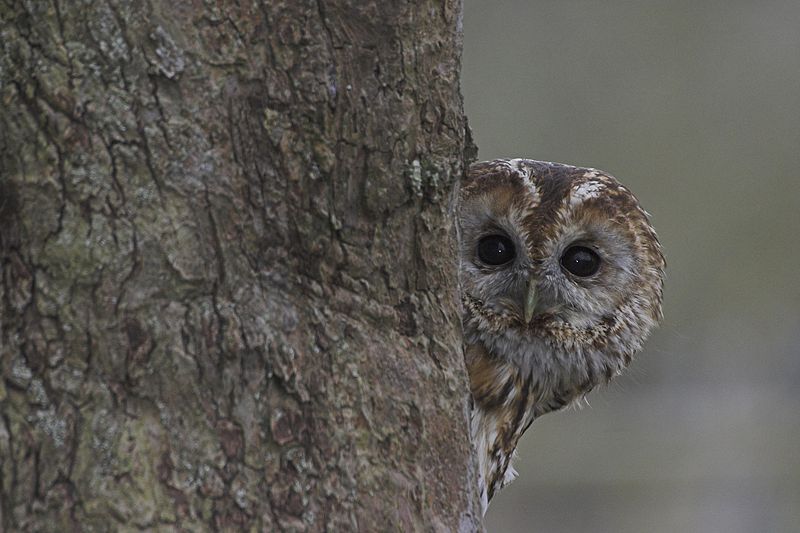
Tawny Owl Strix aluco Linnaeus, 1758

Last night I went to bed in a not great mood, what with the news and all that. And I woke up similarly in a not great mood which has lasted most of the day, just hidden it away, tomorrow is another day. Anyway, before I dropped off to sleep the noise of the night air was punctured by a familiar screech. A Tawny Owl. Tawny Owl’s are resident in the UK, and indeed we have our own sub-species/race/morph (depends who you read!) compared to the rest of Europe and elsewhere. Because Tawny Owls don’t migrate and barely move from their home territories at all they have begun to evolve towards a different species, this is due to the UK has been cut off from mainland Europe for 10,000 years or so, so our owls have not had any new blood so to speak for that long. Birds from Britain are paler in colour than continental birds. For more info see this article: https://www.owlpages.com/download/Martin_and_Mikkola,_2014,_The_Changing_face_of_the_Tawny_Owl.pdf. I love tawny owls but I rarely see them but I hear them most nights. I mean who doesn’t love an owl?!

A really great photo of a tawny owl by Joe Pell (via Wiki Commons)

Advent species so far:

  • 1st: Goosander Mergus merganser
  • 2nd: December Moth Poecilocampa populi
  • 3rd: Horse Chestnut Aesculus hippocastanum
  • 4th Black-headed Gull Chroicocephalus ridibundus
  • 5th Cape Sparrow Passer melanurus
  • 6th Loricera pilicornis
  • 7th Great Tit Parus major
  • 8th Tipula paludosa
  • 9th Redwing Turdus iliacus
  • 10th Bank Vole Myodes glareolus
  • 11th Tawny Owl Strix aluco

Advent Species No.10

10th December

To the year’s archive! Didn’t set foot in the great outdoors today much to my shame, but did life admin instead (still more to do! Hello tax returns!), so today’s species is one I saw over the spring and summer, and similarly to the ground beetle a few days ago this was also found in an amphibian pitfall trap.

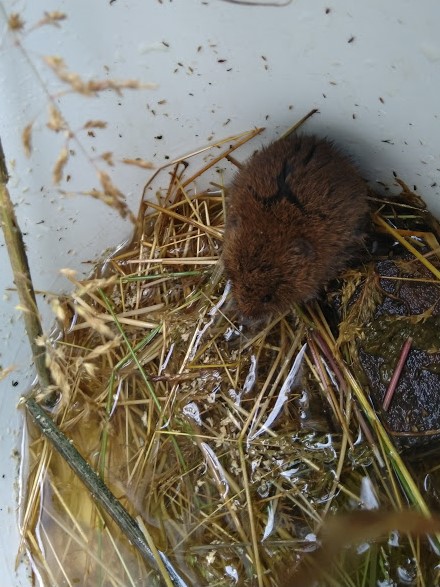
Bank Vole Myodes glareolus (Schreber, 1780)

I met this species, as I said, in a pitfall trap where I almost had a conversation with it. It had fallen in overnight and I was going to fish it out and let it get on with it’s day. I talked to it, as one tends to do with fellow mammals, and it squeaked back before I scooped it out and it ran off. Bank Voles are incredibly common but not many people get to see them as they are secretive and run very fast for their size. This is because Bank Vole is number one on the menu for may creatures, from stoats to foxes to owls and kestrels so they need to be quick and secretive in order to survive. I had to check the ID of mine as there are two similar species on the mainland UK, this one and the field vole. Bank voles are slightly browner in colour than field voles but they are hard to tell apart.

The very vole in the trap. It was more lively than this! Also, if you think this is a field vole do tell me! (Photo: Alex Cropper)

Advent species so far:

  • 1st: Goosander Mergus merganser
  • 2nd: December Moth Poecilocampa populi
  • 3rd: Horse Chestnut Aesculus hippocastanum
  • 4th Black-headed Gull Chroicocephalus ridibundus
  • 5th Cape Sparrow Passer melanurus
  • 6th Loricera pilicornis
  • 7th Great Tit Parus major
  • 8th Tipula paludosa
  • 9th Redwing Turdus iliacus
  • 10th Bank Vole Myodes glareolus

Advent Species No.9

9th December

Back on track! Had a full on day (not doing much important, but little fun things) so I have a subject to write about. And it’s an appropriate one for this time of year as it’s a bird that is pretty common in the run up to Xmas and beyond further into winter.

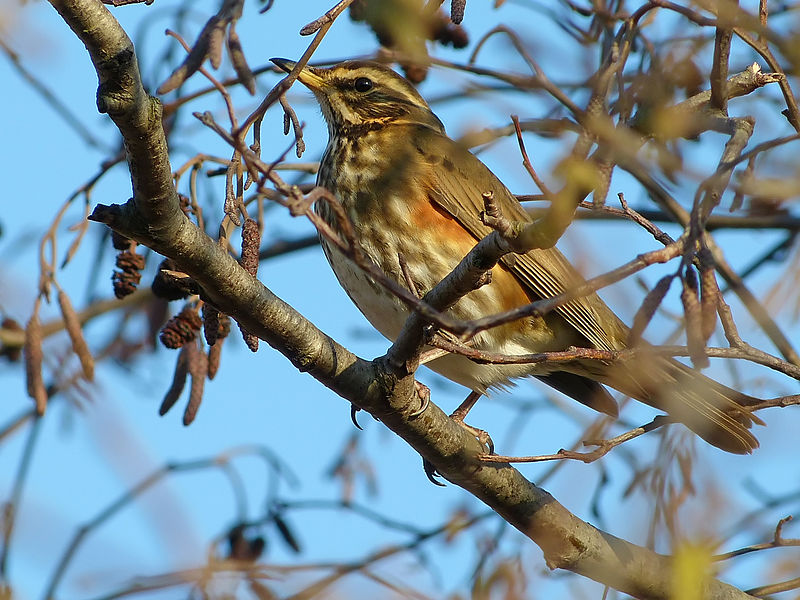
Redwing Turdus iliacus Linnaeus, 1758

This is a small thrush related to blackbirds, song thrushes, mistle thrushes etc. In most of the UK it is only seen during autumn and winter, as this is a winter migrant. The ones we get here breed in eastern Europe and escape the harsh winters there to the slightly milder ones we get here. One of the sure sign that winter is coming is high-pitched call they give whilst migrating during September and October, a characteristic ‘tseep’ that is notable especially at night. Some years seem to have a lot more redwings visiting than others; I’m pretty certain there were way many more last winter than this winter for instance. They traditionally associate with another over-wintering thrush species, the Fieldfare, although I only seem to see them separately.

Redwing (Photo: nottsexminer via Wiki Commons)

Advent species so far:

  • 1st: Goosander Mergus merganser
  • 2nd: December Moth Poecilocampa populi
  • 3rd: Horse Chestnut Aesculus hippocastanum
  • 4th Black-headed Gull Chroicocephalus ridibundus
  • 5th Cape Sparrow Passer melanurus
  • 6th Loricera pilicornis
  • 7th Great Tit Parus major
  • 8th Tipula paludosa
  • 9th Redwing Turdus iliacus

Advent Species No.8

8th December

I know, I know. A day late. So this will the first of two posts written today. The subject of this post came to me when I saw a dead example caught up in the roller-blind in my bathroom, it looked a little silly and decidedly flat as an adornment to the fittings. So obviously this post will be about an insect. Would be rather weird if it were to be about a red deer given that intro!

Tipula paludosa Meigen, 1830

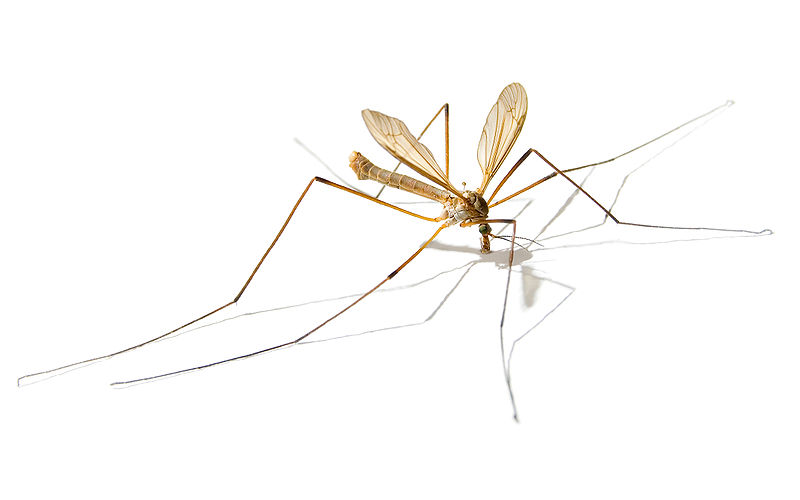
This is a crane fly, also popularly known as a daddy-long-legs. It doesn’t really have an English name in the UK, but is known as the European Crane Fly in North America where it is an introduced pest species. Like many crane flies it has enourmous legs and rather disproportionally small wings. This particular species is incredibly common, and is more noticable in the autumn when they seem to find ways of getting indoors. I think this is more luck than judgement on their part as they seem to be incredibly weak fliers; they always look like they lack direction. Bizarrely for such a poorly designed animal (crane flies must be a very good argument against holy intelligent design) many people are scared of them. I suppose to some folk having an animal fly at you, no matter how much it bimbles aimlessly, and having the same animal getting is legs entangled in your hair – legs that easily fall off, must be a greater source of fear than the entire back catalogue of Stephen King.

The fear inducing Tipula paludosa (Photo: neurovelho via Wiki Commons)

Advent species so far:

  • 1st: Goosander Mergus merganser
  • 2nd: December Moth Poecilocampa populi
  • 3rd: Horse Chestnut Aesculus hippocastanum
  • 4th Black-headed Gull Chroicocephalus ridibundus
  • 5th Cape Sparrow Passer melanurus
  • 6th Loricera pilicornis
  • 7th Great Tit Parus major
  • 8th Tipula paludosa

Advent Species No.7

December 7th

I’m sat here trying to write a job application for a position I really want. But. I really hate writing job applications no matter what the job is for! So in order to get the creative juices flowing and kick-start the writing process I’ll publish a blog post. This time for a common garden bird here in the UK. And, strangely, one I’ve not written about before!

Great Tit Parus major Linnaeus, 1758

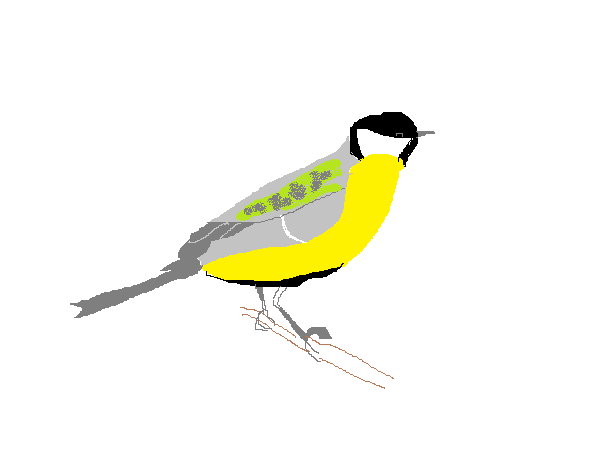
This is an incredibly common garden bird, familiar on bird feeders up and down the country, and indeed elsewhere in Europe. A small group were in the garden earlier. It is perhaps marginally less common than the related Blue Tit but not by much. It is larger than a Blue Tit at up to 14cm in length (or 5.5″ for my American readers). The face is black and white, the breast is yellow with a black stripe and the wings and top half of the bird is grey, but this can be variable. In the spring they will readily utilise garden bird boxes. They make a variety of calls and songs, so much so that if I hear a call I don’t recognise when out and about I always assume Great Tit, and quite often I am correct in the assumption. Their most familiar song sounds like ‘teacher, teacher’ and can be heard in the middle of winter onwards.

One of my patented Paint specials! Unbelievably I don’t have a decent picture of my own of a Great Tit.

Advent species so far:

  • 1st: Goosander Mergus merganser
  • 2nd: December Moth Poecilocampa populi
  • 3rd: Horse Chestnut Aesculus hippocastanum
  • 4th Black-headed Gull Chroicocephalus ridibundus
  • 5th Cape Sparrow Passer melanurus
  • 6th Loricera pilicornis
  • 7th Great Tit Parus major

Advent Species No.6

6th December

I went into my garden today and looked desperately for something that isn’t a bird. A fruitless task when the temperature is 4 degrees Celsius. Sure I can write about a squirrel or a random garden plant but I wanted something a bit more obscure today. I found a lichen on the apple tree, but I have no idea what it is and the internet is no help. So I’ve dug into my 2020 archive of wildlife sightings for something obscure.

Loricera pilicornis (Fabricius, 1775) a ground beetle

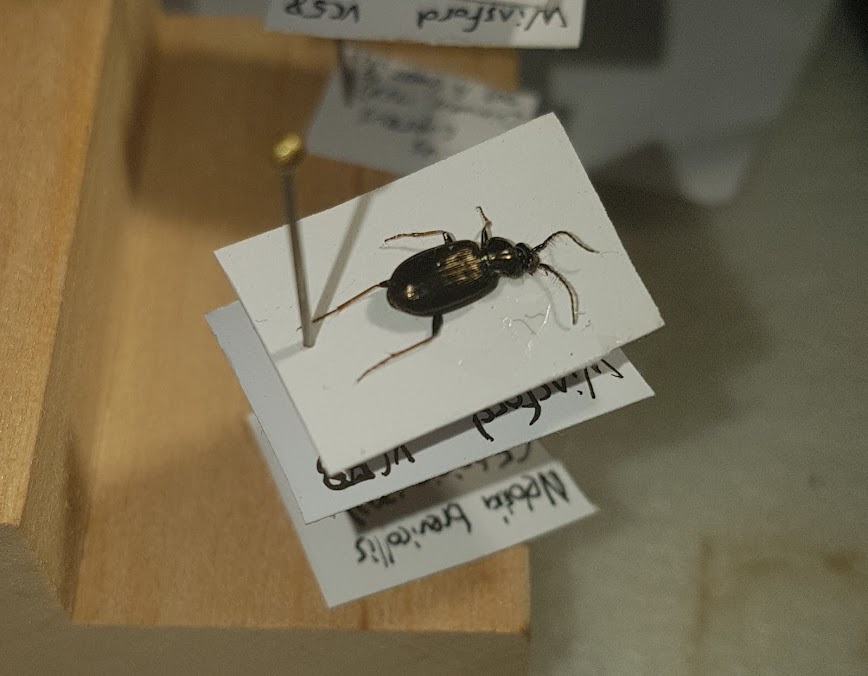
This species doesn’t have an English name yet apparently is one of the most common ground beetles in the UK. I found my specimen in April when I was working as an ecologist. I was checking pitfall traps for newts and other amphibians, but the traps also contained a lot of ground beetles. Me being curious I took a couple of different looking ones home to identify (the site was being developed so the survival chances of most of the beetles was not high so taking one or two to be identified would be of no harm to the general population, the development was seeing to that). It is about 7mm in length, is black in colour and has hairy antenna – the key ID feature. I actually identified it wrong using my book and I was corrected by an expert after I reported my sighting. But I will know for next time, the whole point of learning.

Spot my ID mistake on the lower card! I’m very new to beetle entomology and my attempt at ‘carding’ – sticking specimens to card, isn’t great but you can see all the necessary features despite not being able to untuck the right hand legs (Photo: Alex Cropper)

Advent species so far:

  • 1st: Goosander Mergus merganser
  • 2nd: December Moth Poecilocampa populi
  • 3rd: Horse Chestnut Aesculus hippocastanum
  • 4th Black-headed Gull Chroicocephalus ridibundus
  • 5th Cape Sparrow Passer melanurus
  • 6th Loricera pilicornis

Advent Species No.5

5th December

Blimey this is turning out to be a slog. I’ve been out and about on my bike but barely seen any wildlife. I’m desperately not trying to write about a species on the main list for two days running which doesn’t help matters. I’ve literally sat here for ten minutes before writing this sentence racking my brains for an idea. I think I have one. My parents have got into the habit of watching live bird-feeder cams (I quite like them too for relaxation, I wrote about a species based on a sighting on a cam in January) and a really great one is this one: https://youtu.be/mrvYtcCqVAY which is from Pretoria in South Africa. So today’s species is from there.

Cape Sparrow Passer melanurus (Statius Müller, 1776)

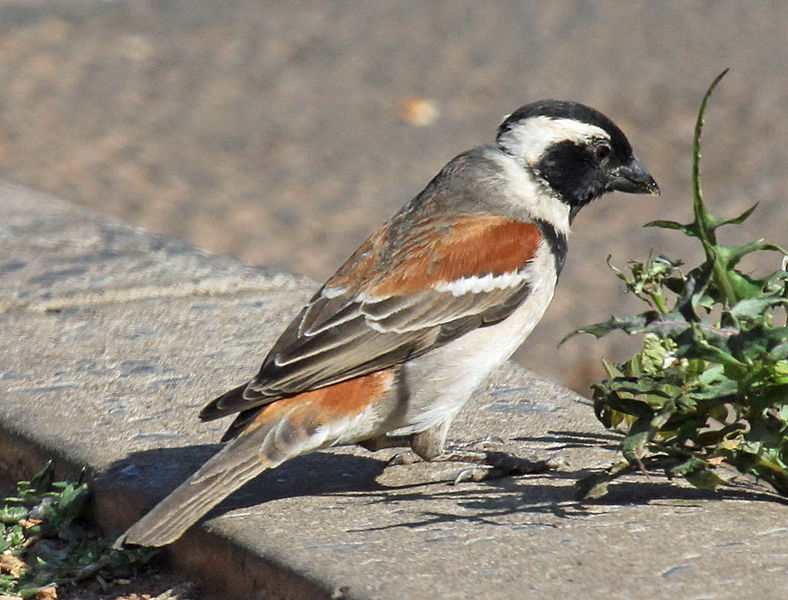
As far as I can tell and with a little help from Wikipedia (and the genus name ‘Passer’ is a giveaway this sparrow is closely related to the UK native House Sparrow which I get in my garden. The males are a lot more spectacular with a black face surrounded by a border of pale cream colour, and a black bib on its breast. The rest of its plumage is similar to a male house sparrow. The females are a lot more drab. There we are, I’ve never seen one in real life, nor do I expect to see one any time soon bar an unexpected trip to South Africa, but that’s my 5th species. Can’t promise I’ll be back to my own sitings tomorrow!

Male Cape Sparrow (Photo: Dick Daniels via Wiki Commons)

Advent species so far:

  • 1st: Goosander Mergus merganser
  • 2nd: December Moth Poecilocampa populi
  • 3rd: Horse Chestnut Aesculus hippocastanum
  • 4th Black-headed Gull Chroicocephalus ridibundus
  • 5th Cape Sparrow Passer melanurus

Advent Species No.4

4th December

Okay, cop out time. Again. Will have to use a species I’ve written about in the main list. Jut another god awful day. One of those days where it feels like the sun hasn’t bothered to come over the horizon. I’ve looked out the window forlornly at the garden and barely seen a bird. I think I’ve seen one. Luckily another bird landed for a split second on the roof of a house opposite which was a little bit more interesting in the scheme of things, but one I’ve written about before. Anyway, without further ado…

Black-headed Gull Chroicocephalus ridibundus (Linnaeus, 1766)

I’ve written about this before (See here: https://wordpress.com/post/speciesaday.family.blog/68) so you can read more about it there. Today’s bird was probably looking for an alternative source of food, garden scraps maybe. Black-headed Gulls are pretty decent scavengers which makes them a very successful species. They don’t often visit gardens, or at least not small gardens like mine, I think they perhaps need a longer run up to take off again – not something easily done in a tennis-court sized shape surrounded by hedges, trees and a house. So I’m guessing today’s bird was looking for scraps in a large garden. It makes species number 4 in the advent calendar. I would guess if you opened a door of an actual advent calendar and found an angry gull on the other side you would be in for a shock.

A 2014 example of a Black-headed Gull (Photo: Alex Cropper)

Advent species so far:

  • 1st: Goosander Mergus merganser
  • 2nd: December Moth Poecilocampa populi
  • 3rd: Horse Chestnut Aesculus hippocastanum
  • 4th Black-headed Gull Chroicocephalus ridibundus
Design a site like this with WordPress.com
Get started