Another 10 days has passed since my last post. Still eeking them out though! I’ve spent probably 5 minutes (but felt like a lot longer) just staring at this screen trying to think of a subject. Truth is I’ve not been out for my own pleasure for ages. The local park is less appealing at this time of year (it’s far better in winter for birds), plus it’s way too busy with one thing or another happening. The local nature reserve has had its gates shut, it’s still open but parking is an issue. Plus, I manage to get out for work, so going out for pleasure almost seems like a bus man’s holiday; I mean it isn’t – I spent 50% of my time at work on a laptop, and being on the computer in my own free time doesn’t feel like a continuation of work for some reason, but maybe the blog does, who knows! I realise I’ve spent most of the last few intros to these things in a similar vein; justifying to myself why I’m doing less of these and explaining away my apathy in general. Anyway, hopefully the next one will have a different intro! On with the show…
What: Smooth Newt Lissotriton vulgaris (Linnaeus, 1758)
When: Every time I survey for work it seems, but also 8th May 2020
Where: My garden, Poynton, Cheshire, UK
Who saw it? My dad and I.
How was it recorded? On the iRecord app.
What is it? One of the three native UK newt species. A few posts ago I featured the Great Crested Newt, which is the largest of the three species and the most highly protected. The smooth is more common and is less picky on habitat, in the breeding season they like smaller bodies of water as well as the slightly larger ponds the Cresties inhabit. They are also less picky in the non-breeding season, where they become terrestrial. It is quite common to find them under plant pots for example in more suburban settings. They are approximately half the size of Cresties and are (as they name suggests) smooth skinned as opposed to the Cresty’s warty rough skin. The males in the breeding season have a large crest like their larger cousins but theirs are uninterrupted all the way from the head to the end of the tail, whereas the Great Crested has a slight pause in the crest where the tail starts. The females are unassuming and mostly light brown in colour (I’ve seen males in both light and dark brown); they are very similar to the closely related Palmate Newt (the third UK native newt). Like all native amphibians they lay eggs in freshwater which develop into a larval tadpole stage before emerging as tiny versions of adults.
Is it larger than a blackbird? No, I’m guessing a blackbird could probably eat a young Smooth Newt they’re that small!
A fact I have learned about this species: Most of the above is new to me this year! However, Wikipedia tells me that Smooth Newts have turned up in Melbourne, Australia this century; presumably as an accidental introduction (my guess of a culprit would be the aquatic garden plant trade?).
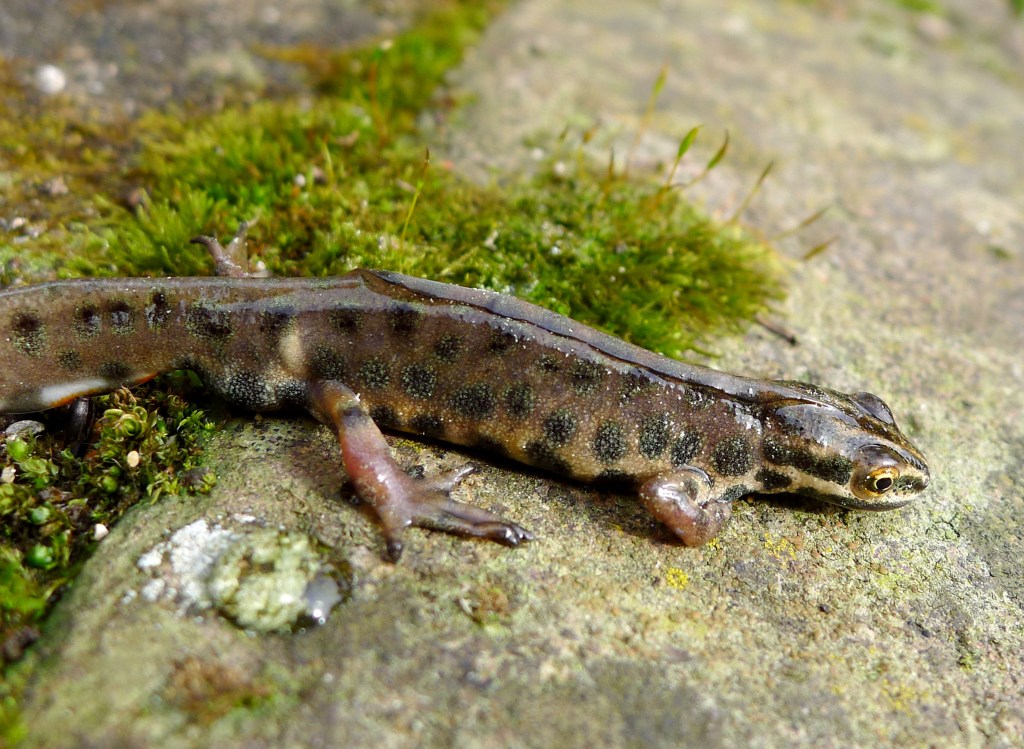
Are they charismatic in my opinion? I think I hold the same opinion I have for the Great Crested Newt. Just about; had you asked me before I worked with them I would have said no but now I’d say so. They don’t exactly appear to do much when on land but in the water they are a different prospect completely, very active after dark and can be pretty numerous.
 A Species a Day
Great post 😁
LikeLike