Today I visited a new site which I’ve only recently been told about. It’s a flooded farmer’s field about 2 miles from my house. It reminded me of several purpose built nature reserves. It’s mostly a ‘lake’ and can be easily observed from the side of the road, and it is teeming with bird life. Yesterday I was told by a local birder that there was a black-tailed godwit seen there, a real rarity for this part of the world; alas it wasn’t there but another more common wading bird was, one (due to me exclusively birding my village this year) I’ve not seen this year.
What: (Eurasian) Oystercatcher Haematopus ostralegus Linnaeus, 1758
When: 21st March 2020
Where: Church Lane Flood, Woodford, Greater Manchester, UK
Who saw it? Me
How was it recorded? Using the eBird app.
Is it bigger than a blackbird? Yes, chicken sized i’d say.
What is it? A black and white wading bird (or shorebird as they are sometimes called in other parts of the world) with an obvious long slender red/orange bill. They are mostly found on the coast but are increasingly common inland like today’s birds. They are very vocal, with a high-pitched piping call. They like to nest in gravelly, or shingle locations where their eggs blend into the scenery. Sometimes the only clue to the eggs’ presence is the frantic calling of the parent bird.
A fact I have learned about this species: Well not exactly about this species… Their North American relatives, the American Oystercatchers Haematopus palliatus are about twice the size of their Eurasian cousins but look practically identical in all other aspects.
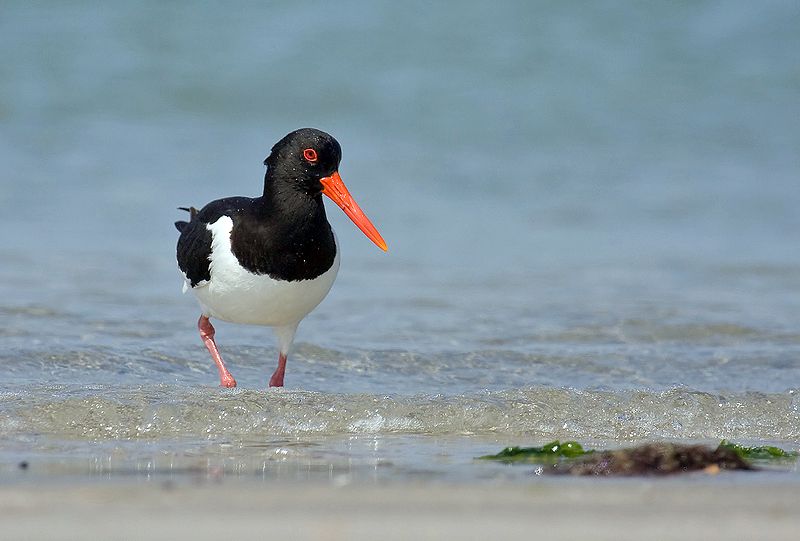
Is it charismatic in my opinion: Yes. I recall vividly having to sneak past a nesting Oystercatcher on my way to my tern colony a couple of years ago on Anglesey. I never managed it, they always knew I was coming and kicked up a huge fuss as I was obviously a threat to them (I wasn’t, but they didn’t know that) . They quickly settled back down once I’d left their territory. Their long orange/red bills amuse me too, it’s like it was stuck on using a ‘parts bin’ of left over bird bits, it looks incongruous to my eyes.
 A Species a Day