Today’s one is a hard sell, it doesn’t even have an English name. Or least an English name that anyone uses. I find outside of the big and bold a lot of experienced folk prefer to use the scientific (or Latin, but it’s not really Latin) name. I’m fine with it some cases (the more obscure stuff) but less so in more common or familiar wildlife. I find scientific names can put people off wildlife and provide a barrier to future learning. Botanists could quite easily use the English (or your local name) instead of scientific, the same with some entomologists (those who study insects). I encountered one person online who insisted on using the latin/scientific name only for the larger moths, despite these moths having well established and memorable names. But I also understand the argument that a scientific name means the same thing wherever you are in the world; it doesn’t change, whereas the common names do, between languages or even within the same language, and many aren’t helpful in identifying something. Anyway, on with the show.. An insect mine like the Ivy from a few days ago.
What: Stigmella aurella (Fabricius, 1775) – (has the tentative English name of Golden Pigmy)
When: 22nd January, 2020
Where: Jackson’s Brickworks local nature reserve, Cheshire (VC58), UK
Who saw it: Me
How was it recorded? Noted down on a spreadsheet and it will be sent off at the end of the year.
Is it larger than a blackbird? No, it’s a small moth.
What is it? A tiny moth whose larvae live in the leaves of bramble (Rubus spp.) and avens (Geum spp.). The larva are really easy to spot, leaving distinct trails within individual leaves. As brambles keep their leaves all year round they are one of the easiest leaf-mining moth species to be found in the winter months. The adults are very rarely seen, but have metallic purple/black wings with a horizontal white stripe two-thirds down the wing.
A fact I have learned about this species? Despite appearing on nearly every bramble bush they seem to be slightly under recorded; probably as not many people will know what it is. They are found throughout Europe.
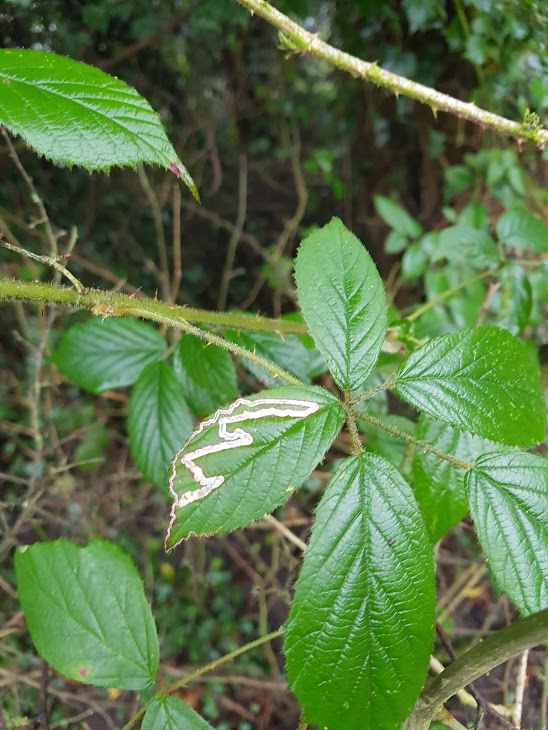
Is it charismatic in my opinion? No idea, don’t know too much to say one way or the other.
 A Species a Day
Great post😀
LikeLike