I have a local birding patch; i.e an area local to where I live that I go on a regular basis to bird-watch. I recommend we all have one. After a period of time you gradually know what lives locally and what doesn’t and at what time of year, it also provides a great excuse to get out and have a walk. So when something unusual turns up, but something that maybe incredibly common somewhere else, it turns into a highlight or rarity. Which is the case of today’s species; not a rarity nationally or even uncommon but pretty scarce where I live; I saw hundreds of this bird during my survey near Preston Docks last week for the consultancy.
What: (Eurasian) Wigeon Anas penelope Linnaeus, 1758
When: 20th January 2020
Where: Poynton Pool, Cheshire, UK
Who saw it: Me and another birder (and reported to me by a third – that’s another thing about a patch, you can chat with other local wildlife enthusiasts)
How did I record it? On eBird. There was 4 individuals, 3 female and 1 male.
Is it larger than a blackbird? Yes. It’s about the same size as a mallard.
What is it? A dabbling duck (one that feeds on the surface rather than diving for its food). The females are a brown colour (like most species of duck) with a white belly, whilst the males are mottled grey/silver on the body and wings with a russet red head and neck with a noticeable yellow forehead. They make a whistling noise rather than a quack. They like to spend a lot of time out of the water to feed, but today’s birds were in the middle of my local lake.
A fact I have learned about this species: They are a comparitively rare breeder in the UK and Ireland, their numbers are augmented by a huge influx from elsewhere in Northern Europe. This influx has increased over the last forty years or so (Ref: Balmer et al (2013) Bird Atlas 2007-11: The breeding and wintering birds of Britain and Ireland BTO Books, Thetford)
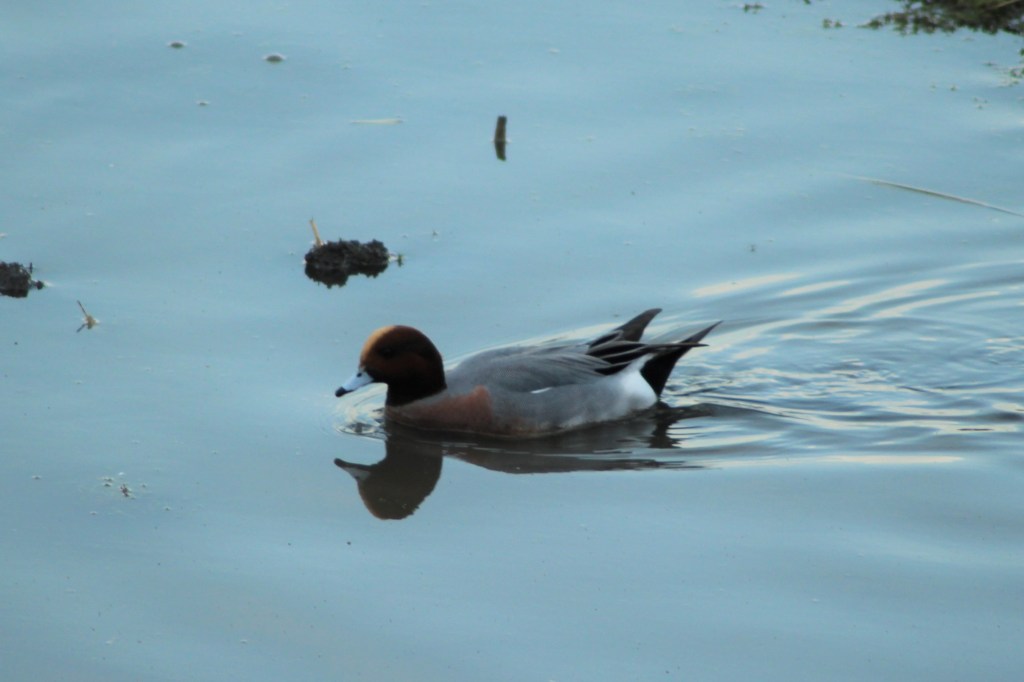
Is it charismatic in my opinion? Yes, all ducks are! I love the way they whistle to each other, definitely sounds like they are having a conversation.
 A Species a Day