Just over halfway gone for my initial target of a one species per day for the month of Janaury (also stayed off alcohol too in this period as an aside). Today it’s back to birds. Yesterday, adjacent to the Yew was a pair of Mute Swans who had swam over the lake and presumably saw me as a source of food (they’re not carnivourous, they were probably demanding bread). One of them had a ring on it’s left leg, not a brightly coloured one which can be read from a distance, rather a metal ring. Normally theses rings (or bands as they are known in other English-speaking countries) will only be read if the bird is dead or recaptured. This bird was so tame I could read it as it was stood next to me.
What: Mute Swan Cygnus olor (Gmelin, 1789)
When: 15th January 2020
Where: Poynton Pool, Cheshire, UK
Who saw it? Me
How did I record it? By sending the number on the ring to the BTO https://www.bto.org/our-science/projects/ringing/about-ringing/why-report-ringed-bird
Is it larger than a blackbird? Yes, significantly so. Nb. Just for clarification on my scale, the blackbird I’m referring to is the European Blackbird Turdus merula. For my American readers this is roughly the same size as the closely related American Robin T. migratorius.
What is it? It’s a mute swan, obviously. Found in most park ponds and lakes in Europe and introduced to North America. Essentially a large white goose with a long neck, orange and black face, and an angry disposition. They do look pretty serene when out on the water, but on the land they come across like a bit of a bully, badgering you for food and making a nuisance. It’s a myth they can break your arm with their wings, but I’m willing to bet they can do damage nevertheless!
A fact I have learned about this species: Their closest living relations are not the migratory swans of the Northern Hemisphere but rather two Southern Hemisphere species; namely the Black Swan Cygnus atratus of Australia and the Black-necked Swan C. melancoryphus of South America.
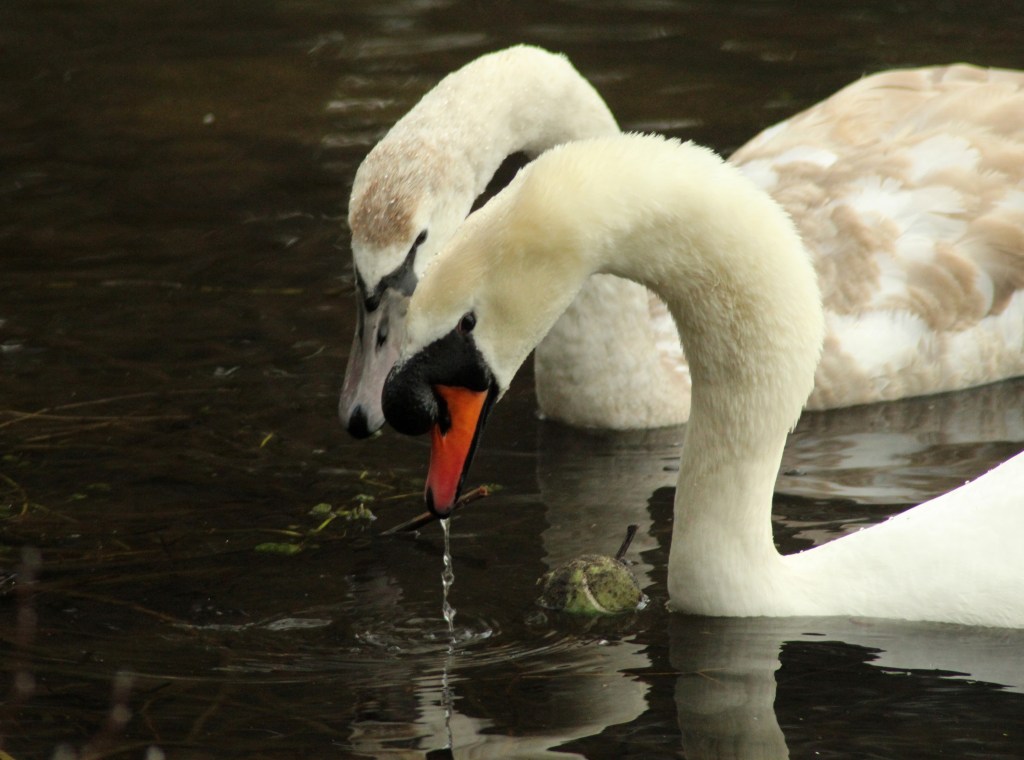
Is it charismatic in my opinion? It’s large and seems constantly angry, so yes.
 A Species a Day