December 17th
This series of blog posts has made me look at, and try to identify, insect specimens that have taken this year. I can be a little un-focussed at times (probabaly the opposite of Asperger’s if that is such a thing) so my mind wanders from one thing to the next, whether it be from being a keen birder one day, to a keen reader the next, or being a keen entomologist the day after that, as a result things can start stacking! Hence I’ve had today’s specimen in the freezer since July. I fully intended to ID the next day but my brain wandered to something else so it remained in the freezer until the other day when I got it out to ID it and record it. Oh yes, it’s another obscure creature today, forgot to mention that!
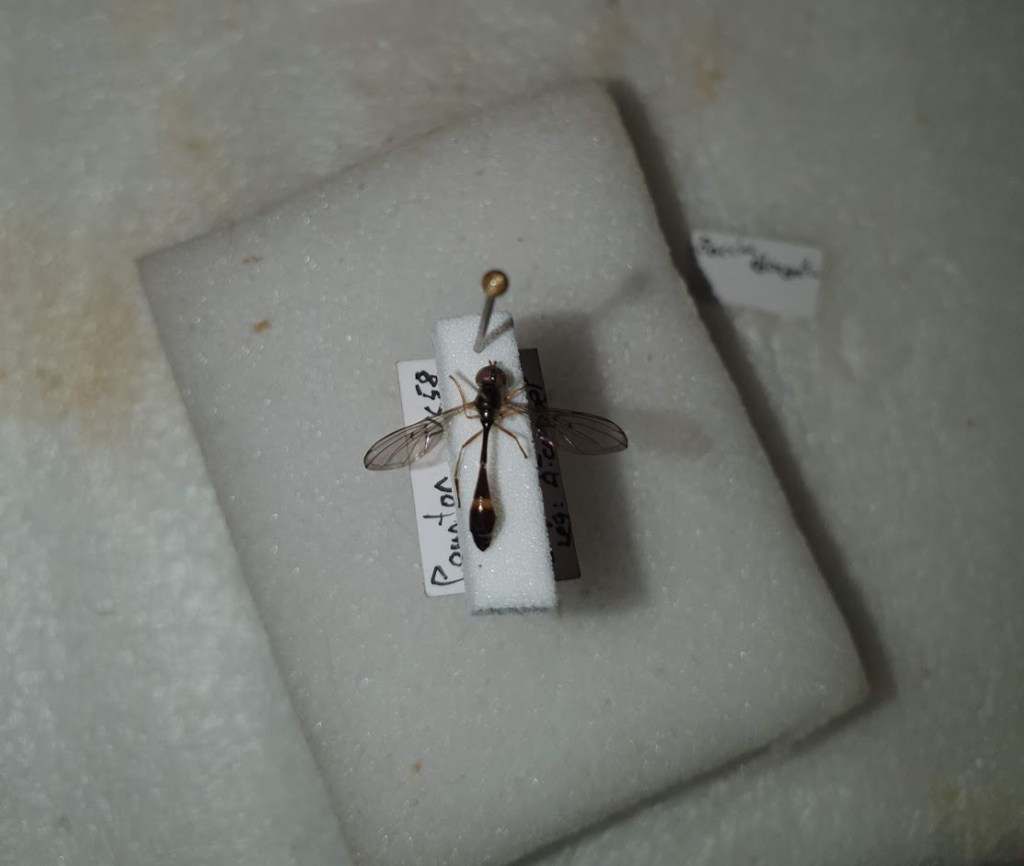
Bacchus elongata (Fabricius, 1775)
No English name so no clue as to what it is just from the name alone (I find this one of the most frustrating aspects with things which only have scientific names). It is a hoverfly (also known as flower flies elsewhere in the world) and one that is pretty easy to identify. It is mostly black with a black face. There are a few yellow markings towards the end of the abdomen but that’s about it. Only, this hoverfly is (relatively) long and thin, a lot thinner than any other thin hoverflies. I certainly won’t be in doubt again when I see another one. Apparently it is relatively common but can be hard to see as they tend not to be obvious unlike many hoverflies. There we go, not sure if there is anything to add.
- 1st: Goosander Mergus merganser
- 2nd: December Moth Poecilocampa populi
- 3rd: Horse Chestnut Aesculus hippocastanum
- 4th Black-headed Gull Chroicocephalus ridibundus
- 5th Cape Sparrow Passer melanurus
- 6th Loricera pilicornis
- 7th Great Tit Parus major
- 8th Tipula paludosa
- 9th Redwing Turdus iliacus
- 10th Bank Vole Myodes glareolus
- 11th Tawny Owl Strix aluco
- 12th Sparrowhawk Accipiter nisus
- 13th Kingfisher Alcedo atthis
- 14th Nebria brevicollis
- 15th Virginia Opossum Didelphis virginiana
- 16th —–
- 17th Bacchus elongata
 A Species a Day