It’s unseasonably mild here in my bit of the UK (not warm though!) with the overnight temperature last night falling to 11 C (double it and add thirty for a rough figure in Fahrenheit). There was no wind, barely any rain and good cloud cover, so a great night to survey moths in late autumn. I have written about this before but one of the best ways to survey moths is to leave a light-trap out overnight which moths are attracted to and then fall into (there are other cheaper ways of doing this such as leaving a light on in a room in your house with the window open and catching anything that may come in). Anyway, that is how I did it last night. I wasn’t expecting a lot due to the time of year but was pleasantly surprised when a handful were waiting for me when I checked the trap this morning, including the subject of today’s post.
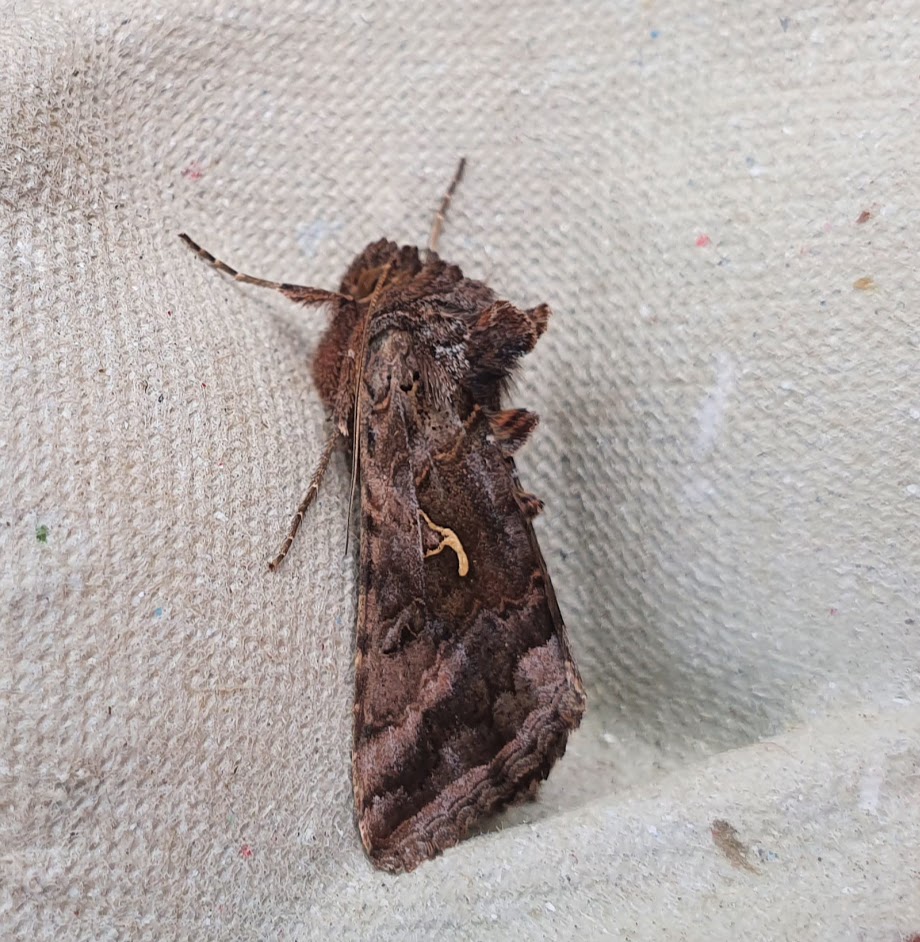
What: Silver Y Autographa gamma (Linnaeus, 1758)
When: 9th November 2020 (The date is always recorded as the day you put the trap out, not when you checked it).
Where: My garden, Poynton, Cheshire, UK
Who saw it? Me
Rough translation of scientific name: Autographa gamma – Written gamma (third Greek letter). Or written lower-case gamma more specifically.
What is it? A very common moth which can be found in the UK in practically every month of the year, but more often between late spring and early Autumn. However, unlike many moths found in my garden this moth is an immigrant, it, or it’s direct parents or grand-parents were. It (or they) would have made their way from southern Europe where the species is resident. Why some of them choose to migrate north is unknown to me, but they do so very regularly; I’m no idea if they go back again! Some may directly migrate north and find their way to our shores but they probably breed on the way, so the next generation takes on the baton and continues the journey.
Anyway, it is a fairly large moth with the forewing measuring up to about 20mm and is variable in colour although it is usually a degree of grey or brown, but always with a metallic silver ‘Y’ shaped marking, giving it both it’s English name and Scientific name, with the lower-case gamma being very similar to the lower case ‘y’ in the Latin alphabet.
Is it charismatic in my opinion? Probably, it certainly stands out with the ‘Y’ marking, and you know it has travelled far to get to you. It’s a good moth to learn when starting out too. But they are very common, but I think we need to appreciate the common as much as the rare in my opinion.
 A Species a Day