My dad shouted up earlier today (I’m living with the folks during the Covid crisis) ‘there’s two Elephant Hawk-moths on the tree under the bird feeder!’ This I had to see. Now sure enough there were two large hawk-moths right where he said, and they were elephant grey in colour. And they clearly liked each other very much. Just they weren’t Elephant Hawk-moths, which are pink and yellow, a lot like African Elephants, they were Poplar Hawk-moths.
What: Poplar Hawk-moth Laothoe populi (Linnaeus, 1758)
When: 14th June 2020
Where: My garden, Poynton, Cheshire, UK
Who saw it? My dad and I.
How was it recorded? Logged on my moth spreadsheet to be sent to the county recorder at the end of the year.
Is it bigger than a blackbird? Even though it is big for a moth it is not bigger than a blackbird.
What is it? A large common grey hawk-moth. A starter hawk-moth if you would, but nevertheless it looks spectacular. Dark grey in colour with wings that looks like they’ve been cut out from an odd pattern and stuck haphazardly onto the insect. The body of the moth is furry and broad where the insect’s fat reserves are held, it needs these as it doesn’t feed as an adult. It does all its eating as a larva. The adult stage is purely there to reproduce. They turn up all the time in moth traps, hence a starter moth, but they are the sort of moth to get you hooked. Butterflies take all the glamour credit, but moths are where it at.
A fact I have learned about this species: Female hawk-moths are attracted to light before midnight, males after. They must have wristwatches…
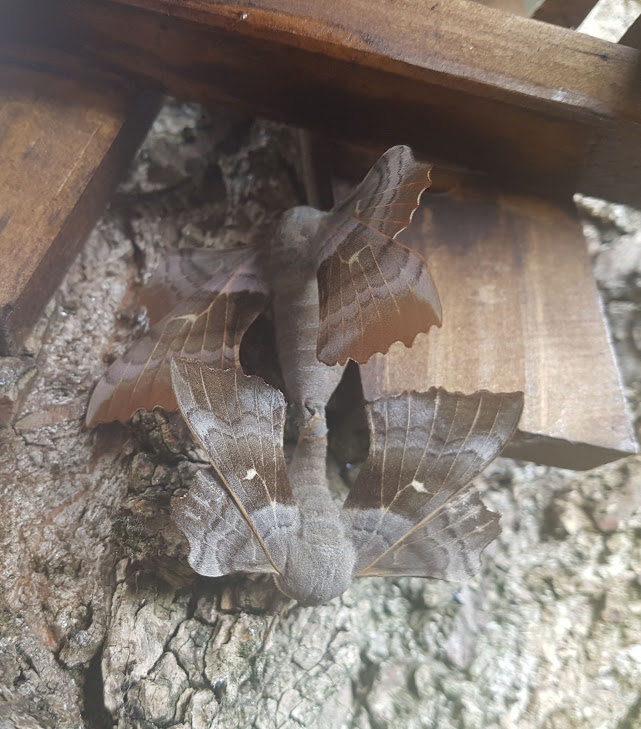
Are they charismatic in my opinion? Yes. Just look at them!
 A Species a Day