I’ve finally started on bats for my new company! For most of last summer I was a sub-contractor for a local ecologists and 90% of my work was assisting with bat surveys; which basically involved sitting and staring at a corner of a building for an hour or so around dawn or dusk. This was aided by a variety of bat detectors; I was normally given a smart bit of tech which clips on to an iPad or similar and runs an app which converts bat echo-locations into sounds humans can hear, as well as converting it into a sonogram so we can see the bat call, and thirdly tried to ID the bat. The latter was hit in miss with many species, dogs barking and keys jangling were often ID’d as Noctule bats. My new company doesn’t use the clever tech, it uses older tech to silently record bats and a handheld hetrodyne detector which the user has to twiddle around to pick up different bat types (usually set to 45 kHz as a default). My new company doesn’t seem to do many buildings either, this morning I was staring at a tree and a couple of nights ago I was staring at a cave entrance. Where I saw today’s subject…
What: Lesser Horseshoe Bat Rhinolophus hipposideros (Bechstein, 1800)
When: 27th May 2020
Where: The UK (got to be vague on this one I think).
Who saw it? My colleague and I.
How was it recorded? On a form which goes into the local record centres.
Is it bigger than a blackbird? No, a small bat. Think about a mouse with wings and your’re almost there (the wings do make them seem a little bigger than a mouse though).
What is it? A pretty special bat. Well all bats are special in my opinion but some are more special than others to paraphrase Animal Farm. All of my previous bat surveys have involved the commoner species, pipistrelles mostly along with a smattering of Noctules, various Myotis species and if we were really lucky Brown Long-eared Bats. Pretty much all these have an association with humans, or live in open countryside. The Lesser Horse-shoe is much rarer and more picky where it lives. They (and I’m only basing this on my survey the other day), live in caves during the winter (and maybe some abandoned buildings in the summer I believe) and behave almost like stereotypical spooky bats. They like to fly around in their caves to warm up before they begin to emerge and go about their nightly business and like to wrap themselves up in their wings whilst hanging upside down from roofs. They also emit a spooky noise when converted through a bat detector. They are now emerging from their winter cave roosts and will head to their various summer breeding roosts. They are a declining species and are now extinct in various places in England. This is more than likely due to disturbance or destruction of their breeding sites amongst other reasons. They are light brown in colour and have one of those ugly bat noses which is shaped like a horseshoe, which gives them their English name.
A fact I have learned about this species: All of the above is new to me! But, they (along with the even rarer in the UK Greater Horseshoe Bat) use a unique type of echolocation which is both more constant, and higher in frequency (110 KHz) than the rest of the UK bat fauna.
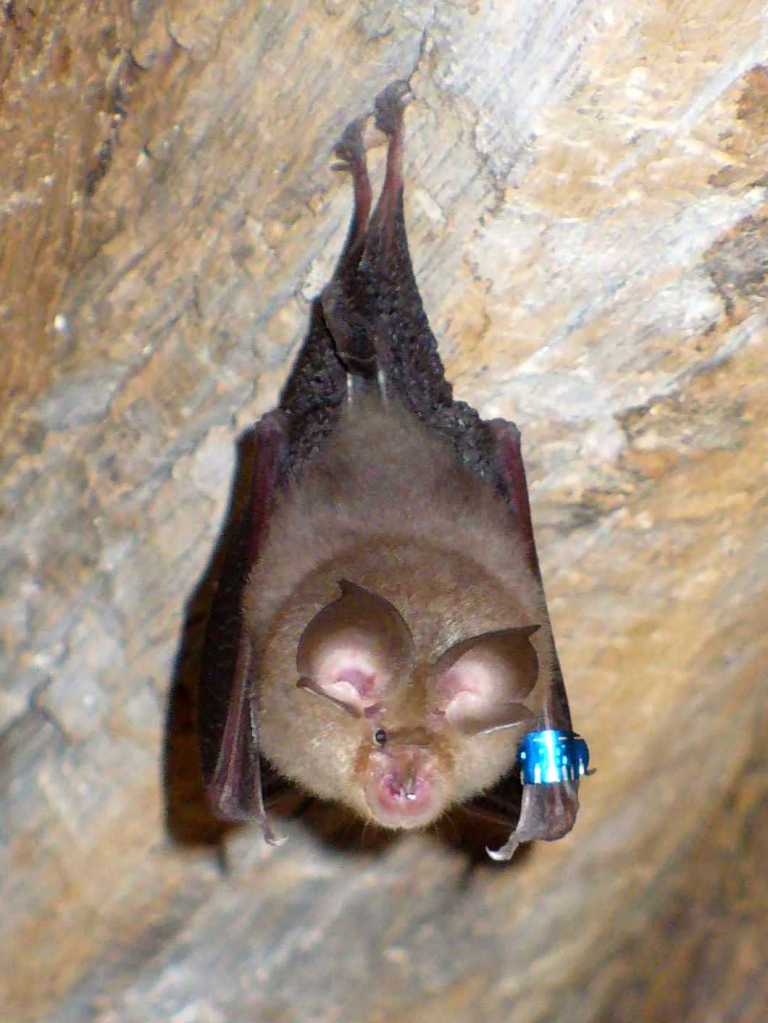
Is it charismatic in my opinion? I think from my enthusiastic write up this gets a big yes. Obviously all bats are enigmatic too, you barely see them, but when you get to know them they are full of character.
 A Species a Day